Key Takeaways
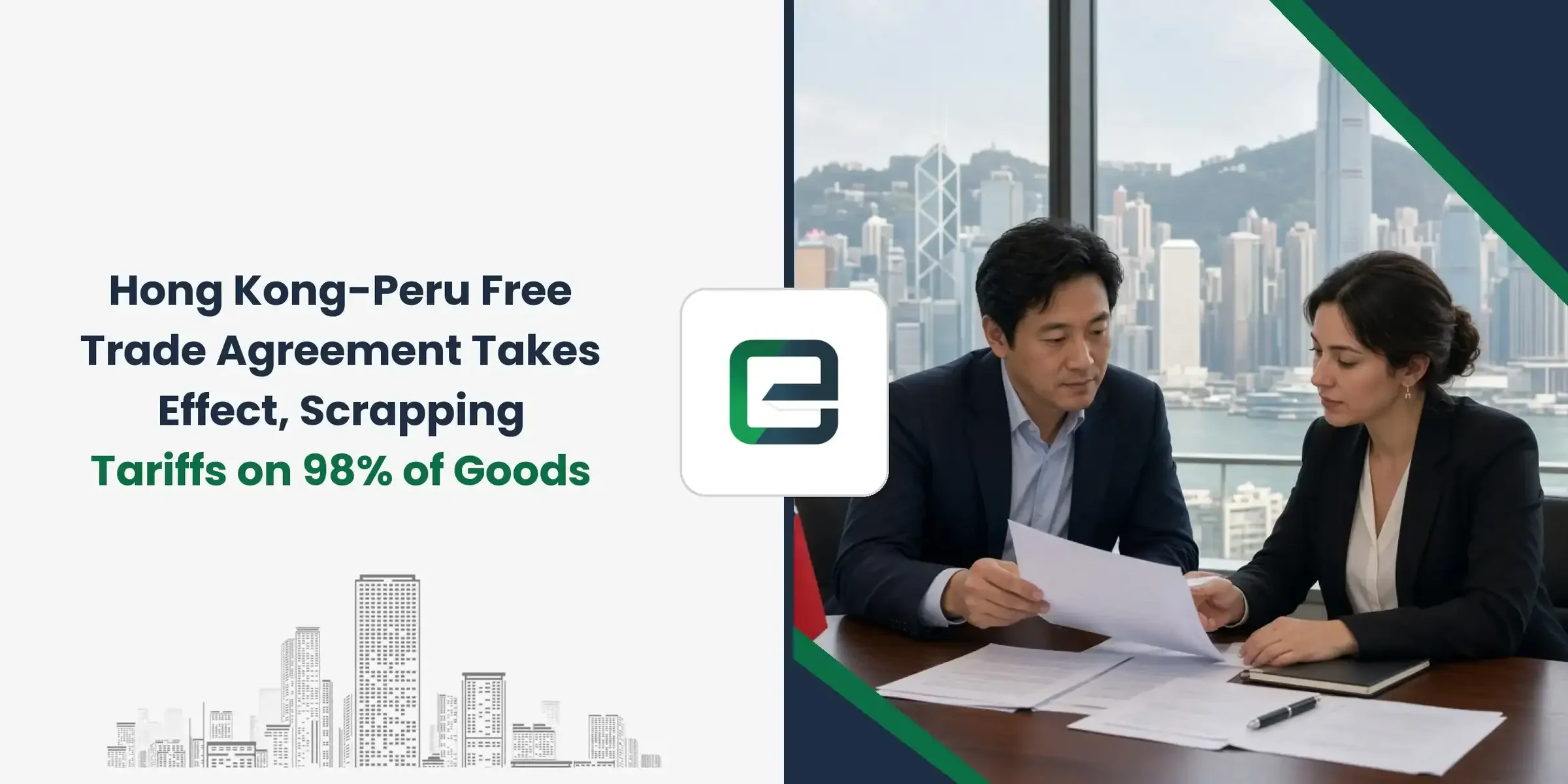
- The Hong Kong Peru Free Trade Agreement entered into force on 1 September 2026.
- Peru will eliminate tariffs on about 98.3% of its tariff lines for Hong Kong-origin exports.
- Duties on 91.3% of tariff lines are removed immediately; the remaining 7% will be phased out gradually.
- Hong Kong service providers gain access to more than 150 services sectors in which Peru has made commitments.
- Peru will accord Hong Kong investors national treatment, with a separate investment protection agreement to follow.
- The deal is Hong Kong's second FTA with a Latin American economy, bringing its total to nine FTAs covering 21 economies.
When Did the Hong Kong Peru Trade Deal Take Effect?
The Hong Kong Peru Free Trade Agreement entered into force on 1 September 2026, following the completion of internal procedures by both sides. The Hong Kong Special Administrative Region (HKSAR) government confirmed the date. The deal was originally signed in Lima on 15 November 2024 and entered into force almost two years later.
Peru ratified the agreement through a supreme decree published in the official gazette El Peruano on 15 July 2026. Under Article 20.4 of the agreement, entry into force follows 60 days after the parties exchange written notifications. These notifications confirm that internal procedures are complete, or the parties may agree on another date. Both sides settled on 1 September 2026, and a parallel letter on professional services took effect on the same day.
The Trade and Industry Department (TID) has published the full text of the agreement on its website. It has also issued trade circulars to inform traders of the preferential rules of origin and related requirements. Exporters and service providers should review these circulars before claiming any new preferences under the deal.
How Does the Hong Kong Peru Free Trade Agreement Tariff Elimination Work?
Under the agreement, Peru has committed to removing import duties on roughly 98.3% of its tariff lines for goods originating in Hong Kong, per the TID. This covers almost the entire tariff schedule the city's exporters face when entering the Peruvian market. A further 0.6% of Peru’s tariff lines are subject to partial tariff elimination upon entry into force, while the remaining 1.1% continue to be subject to customs duties and will be considered for liberalisation in the fifth year.
The phase-out runs on two tracks. When the agreement entered into force on 1 September 2026, duties were scrapped straight away on 91.3% of tariff lines. Another roughly 7% of lines will see their duties removed progressively under the timeline in the agreement's tariff schedule, giving sensitive product categories a longer transition.
Exporters claiming the preferential rates must ensure their goods qualify under the preferential rules of origin in the agreement and satisfy the accompanying documentation requirements. The product-specific phase-out timetable sits in the agreement's tariff schedule. Each phased line is assigned to a staging category with its own removal date. The TID circulars direct traders to consult the schedule before claiming any preference. In practice, we advise trading clients to check origin documentation and shipping calendars early. The deal also brings benefits beyond lower duties. Its customs and trade facilitation chapter obliges both sides to:
- streamline clearance procedures
- speed up the release of goods
- reduce related red tape at the border
Which Sectors Gain Market Access Beyond Goods?
Beyond goods, the agreement opens Peru's services market to Hong Kong suppliers. Peru has bound itself with specific commitments spanning more than 150 services sectors, among them professional services, computer and related services, research and development, financial services and transport services. A parallel letter on professional services came into operation alongside the agreement on 1 September 2026, giving Hong Kong professionals added certainty about practising in Peru.
On the investment side, the FTA entitles Hong Kong investors to national treatment in the sectors Peru has listed. This means they will be treated on par with local investors when setting up and running businesses in those areas. In addition, the two sides have finalised a separate Investment Promotion and Protection Agreement. It will be signed after each completes its internal procedures. The agreement adds another layer of legal protection for Hong Kong investments in Peru.
Supporting chapters tackle non-tariff frictions as well. The trade facilitation chapter obliges both parties to simplify customs procedures and speed up the release of goods. Meanwhile, the electronic commerce chapter promotes paperless trading and keeps digital flows open for businesses on both sides.
What the Agreement Means for Hong Kong's Trade Network
The deal is Hong Kong's second free trade pact with a Latin American economy, after Chile. Counting Peru, the city now has nine FTAs spanning 21 partner economies, reaching several of the world's largest and fastest-growing consumer markets.
Hong Kong's current FTA partners are:
- The Mainland
- New Zealand
- The European Free Trade Association (EFTA) states — Iceland, Liechtenstein, Norway and Switzerland
- Chile
- Macao
- The 10 member states of the Association of Southeast Asian Nations (ASEAN)
- Georgia
- Australia
- Peru
For Hong Kong's commerce authorities, the agreement offers a base for building commercial ties with Peru and, more broadly, for reaching customers across Latin America. Peru's economy expanded 3.3% in 2024, according to the Central Reserve Bank of Peru, highlighting the draw of the market. For exporters, tariff-free entry into Peru improves price competitiveness where duties have actually been removed. Duties on 91.3% of tariff lines were scrapped immediately, and a further 7% will be phased out over time. Goods qualifying as Hong Kong-origin therefore gain a growing edge as the phase-out progresses.
In practice, we help traders and investors position their Hong Kong operations to capture new FTA opportunities. That support runs from incorporation through post-incorporation compliance steps and market-entry planning. Founders planning an entry timeline usually start by checking how long it takes to register a company in Hong Kong. Overseas traders can also open a company in Hong Kong without a local director. A Hong Kong company may appoint a non-resident director, provided the usual registration and secretary requirements are met.
From there, the operational steps can be mapped out product by product. Businesses map export and investment timelines against the phased tariff reductions, cross-checking Peru's tariff-line schedules and origin documentation for each product they plan to ship. Every Hong Kong company must also meet ongoing statutory requirements, including annual returns, audits of accounts where applicable and Business Registration renewal, which we factor into market-entry planning from day one. Foreign founders should also review common Hong Kong company setup mistakes before committing to a market-entry plan.
Frequently Asked Questions
The agreement entered into force on 1 September 2026, after both sides completed their internal procedures and exchanged written notifications. A parallel letter on professional services took effect on the same date.
Peru will eliminate tariffs on approximately 98.3% of its tariff lines for Hong Kong-origin exports. Tariff elimination on 91.3% of tariff lines took immediate effect, while duties on the remaining 7% will be phased out gradually.
Hong Kong service providers gain access to more than 150 services sectors in which Peru has made specific commitments, including professional services, computer and related services, research and development, financial services and transport services.
No. It is Hong Kong's second FTA with a Latin American economy, after Chile. Including Peru, Hong Kong has signed nine FTAs covering 21 economies in total.
Peru will accord Hong Kong investors national treatment in areas specified under the agreement. A separate Investment Promotion and Protection Agreement has been concluded and will be signed once both sides complete their internal procedures.