Why Do Deduction Restrictions Matter?
A company might only discover at audit time that household costs are not deductible and that capital withdrawals are generally not deductible, but qualifying business-premises refurbishment and commercial or industrial building expenditure can attract deductions or allowances, while untaxed offshore interest is deductible only when the applicable conditions are met.
The Inland Revenue Department (IRD) applies a gatekeeping test to decide which expenses qualify under Hong Kong's profits tax deduction restrictions. In this guide, we outline the six restrictions the IRD applies most often, from private spending to related-party interest. Under section 16(1) of the Inland Revenue Ordinance, outgoings and expenses are deductible to the extent they are incurred in producing chargeable profits. Everything outside that boundary is added back, and repeated errors invite field audit. Get in touch with 3E Accounting Hong Kong to review your deduction schedule before the next Profits Tax Return.
Are Private Expenses Deductible?
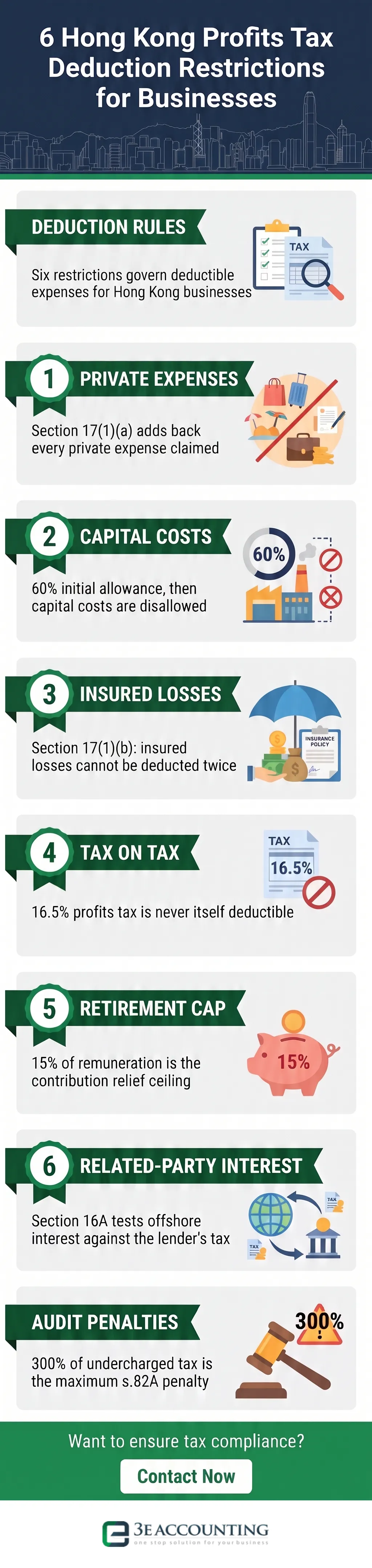
Section 17(1)(a) of the Inland Revenue Ordinance denies every domestic or private expense. Private household and holiday expenses are not deductible as business expenses, but a company's cost of providing a car as employee remuneration can qualify even when the car is used for commuting. Non-deductible private payments are added back in computing assessable profits; overdue tax can attract surcharges, and a judgment debt can attract interest. Keep personal spending out of the company ledger entirely.
Capital Withdrawals and Improvements
Machinery and plant purchases earn a 60% initial allowance under Part 6 of the Inland Revenue Ordinance. Annual allowances for plant and machinery are 10%, 20% or 30% on reducing value; qualifying computer hardware and software expenditure can be written off immediately. These rates have applied since the 2018/19 year of assessment. Capital withdrawals are not deductible, but qualifying business-premises refurbishment expenditure and qualifying commercial or industrial building expenditure can attract deductions or allowances. Repairs that merely restore an asset remain deductible.
Are Insured Losses Deductible?
Section 17(1)(e) of the Inland Revenue Ordinance disallows any sum recoverable under insurance or a contract of indemnity. A fire claim, stock damage or business interruption payout is not itself a deductible expense. The insured loss cannot also be claimed as a deduction. Where an insurance recovery replaces chargeable profits, that recovery is separately taxable. Claiming the loss as a deduction would double-count relief. Only the uninsured excess of each loss qualifies.
Profits Tax and Ordinance Levies
Hong Kong's headline corporate profits tax rate has stood at 16.5% since the 2018/19 two-tiered reform. Under section 17(1), tax payable under the Ordinance itself is never deductible. That covers both tiers — 8.25% on the first HK$2 million of chargeable profits, 16.5% above — plus provisional profits tax. Late-payment surcharges are also not deductible, while interest on tax in default is generally disallowed as a tax shortfall. The exception is salaries tax an employer pays for an employee, deductible as a staff benefit.
Excessive or Unapproved Retirement Contributions
Ordinary or regular employer contributions to a recognised retirement scheme are deductible up to 15% of the employee's total emoluments for the relevant period; qualifying special contributions are deductible evenly over five years. Section 17(1) adds back every dollar above that ceiling for the period the contribution relates to. Mandatory MPF employer contributions remain deductible in full. Payments into non-recognised schemes receive no relief, so structure voluntary contributions carefully at year end.
Non-Compliant Related-Party Interest Expenses
For an offshore associate's interest, section 16(2)(g) of the Inland Revenue Ordinance uses a 16.5% standard overseas tax reference rate, or 8.25% where section 14D(1) applies. This route requires an eligible intra-group financing business and other conditions, including the lender's right to use and enjoy the interest. Other section 16(2) routes may apply where interest is chargeable to Hong Kong profits tax or the lender is a financial institution. Deductibility of untaxed offshore interest depends on the applicable route and its conditions. Consider the borrowing's purpose and anti-avoidance tests. Document the lender's tax position.
Summary of deduction restrictions
| Expense | Treatment |
|---|---|
| Domestic or private expenses | Not deductible |
| Eligible plant and machinery | 60% initial allowance |
| Recognised retirement scheme contributions | Up to 15% of an employee's total remuneration |
Common IRD Audit Pitfall
Section 82A of the Inland Revenue Ordinance allows penalties up to 300% of the tax undercharged. Understating profits by breaching Hong Kong profits tax deduction restrictions routinely triggers IRD queries. Private costs, untaxed related-party interest and excess retirement contributions can lead to field audits and interest on tax in default. We keep expense schedules audit-ready for clients of our Hong Kong company incorporation services and long-established groups alike.
Need Help With Your Hong Kong Deductions?
We review expense schedules and prepare defensible profits tax computations for companies of every size.
Frequently Asked Questions
No. Section 17(1)(a) of the Inland Revenue Ordinance disallows domestic or private expenses, including a director's household rent and private commuting costs. However, a company's cost of providing a car as employee remuneration can qualify even when the car is used for commuting.
No. Under section 17(1), tax payable under the Ordinance — including provisional profits tax charged at 8.25% and 16.5% — is never deductible. Salaries tax an employer pays for an employee is the exception, deductible as a staff benefit.
Up to 15% of each employee's total remuneration for the relevant period. Mandatory MPF employer contributions are deductible in full, while payments into non-recognised schemes and any excess above the cap are disallowed.
Possibly. Interest paid to an overseas parent may qualify under section 16(2) if the relevant conditions are met. These include routes based on Hong Kong taxation of the interest, financial-institution lending and certain intra-group financing arrangements. The purpose of the borrowing and anti-avoidance rules also matter.
The IRD can impose a penalty of up to 300% of the tax undercharged under section 82A, with interest on tax in default. Field audits typically follow where private expenses or related-party interest are misclassified.

Abigail Yu
Director
Abigail Yu oversees executive leadership at 3E Accounting Group, leading operations, IT solutions, public relations, and digital marketing to drive business success. She holds an honors degree in Communication and New Media from the National University of Singapore and is highly skilled in crisis management, financial communication, and corporate communications.