A Hong Kong company's bank KYC review notice often arrives after its shareholders, directors or business lines have changed. The work is to reconcile the bank's records with the company's current position.
This guide reflects 3E Accounting Hong Kong's practitioner experience. In this article, we discuss:
- Why banks conduct periodic reviews and what documents they typically request
- How to reconcile ownership and business changes with dated records
- How to explain questioned transactions factually
- What to do when a document is missing
- How to submit the pack securely and within proper authority
Why Does a Hong Kong Company Face a Bank KYC Review?
A periodic review is a scheduled regulatory control, not an accusation. Banks must keep customer information current under Hong Kong's anti-money-laundering framework.
The Hong Kong Monetary Authority (HKMA) requires banks to collect customer information periodically. It also requires a risk-based approach to customer due diligence. Banks must identify and take reasonable measures to verify corporate customers' beneficial owners. They must understand each customer's ownership and control structure. The HKMA does not prescribe an identical trigger, frequency or document list for every customer. What a particular bank requests depends on the company's risk profile and circumstances.
A review letter should not be treated as a bureaucratic formality with a fixed checklist. A review applies the same discipline as account opening, reapplied to the company as it stands today. A company whose shareholders, directors, markets or trading activity have changed since onboarding should expect questions. It should prepare accordingly.
What Documents Does a Bank Periodic Review Typically Request?
A Hong Kong bank's periodic review usually asks for four groups: identity, structure, financial activity and supporting commercial evidence.
A Hong Kong bank's periodic KYC review may request:
- The certificate of incorporation and current business registration certificate
- The latest annual return (Form NAR1) and an ownership chart
- The registers of members and directors
- Identity and residential-address evidence for relevant individuals
- Financial statements and recent management accounts
- Sample purchase and sales contracts and invoices
- Explanations for selected transactions
- For a new corporate shareholder, the bank usually asks for that entity's incorporation and ownership documents too. This lets the bank identify the individuals behind it.
The exact list varies by bank and by customer. Start with a comparison. Set the bank's request and existing customer profile against dated statutory records, ownership charts, accounts and current business activity. We recommend this reconciliation before any document is collected, because it surfaces inconsistencies early. Most statutory documents originate at formation. Clients engaging our Hong Kong company incorporation services receive an organised set from the outset. This makes later reviews far easier.
How Do You Reconcile the Bank's File With the Company's Current Position?
Before assembling anything, compare three records side by side: the statutory position, the accounting position and the bank's customer profile.
This three-way comparison can reveal inconsistencies that might delay a review. The bank's file may still carry an ownership chart and business description from onboarding. The company's registers and accounts have moved on. Checking the three positions together can surface inconsistencies before the bank does, which is the point.
1. Establish the statutory position
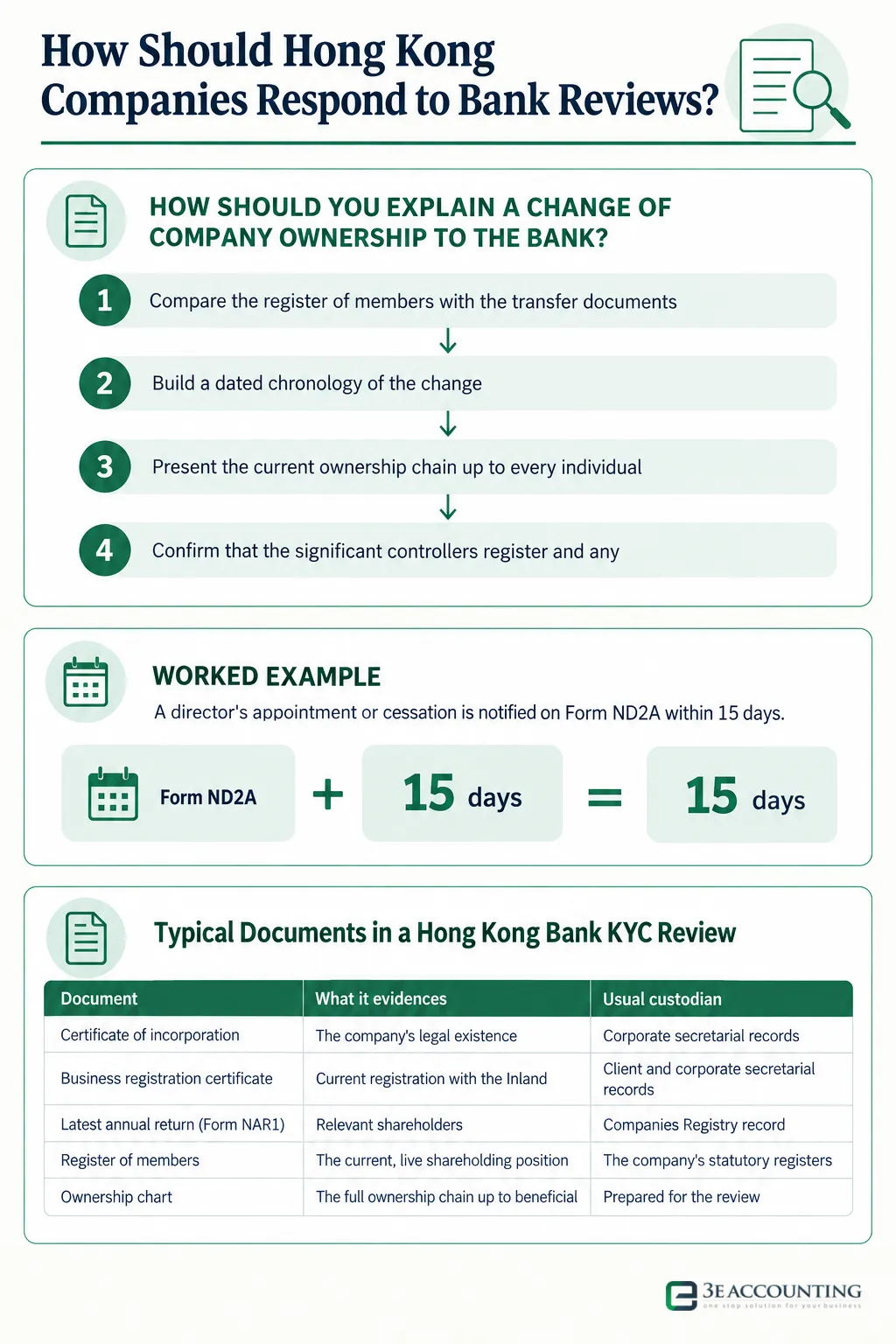
Start with dated statutory records: latest annual return, registers of members and directors, and significant controllers register. Each record speaks as at its own date. A January annual return and a May share transfer can both be accurate. Check which filings were due. A director's appointment or cessation is notified on Form ND2A within 15 days. Do not rely on the annual return to carry every change.
2. Establish the accounting position
Management accounts, contracts and actual transactions show what the company now does. Where deposits or revenue lines appear that the bank's business description does not mention, expect questions. Compare the current business description with contracts, management accounts and actual transactions. Prepare a factual explanation of any material change.
3. Reset the bank's customer profile
Prepare a dated change chronology, an old-versus-current ownership chart and a document index explaining which document evidences each change. Present the company as it stands today, with the paper trail showing how it got there.
Typical Documents in a Hong Kong Bank KYC Review
| Document | What it evidences | Usual custodian |
|---|---|---|
| Certificate of incorporation | The company's legal existence and incorporation date | Corporate secretarial records |
| Business registration certificate | Current registration with the Inland Revenue Department | Client and corporate secretarial records |
| Latest annual return (Form NAR1) | Relevant shareholders, directors and registered office as at the return’s made-up date | Companies Registry record |
| Register of members | The current, live shareholding position | The company's statutory registers |
| Ownership chart | The full ownership chain up to beneficial owners | Prepared for the review |
| Identity and address proofs | Identification of directors and beneficial owners | The individuals concerned |
| Audited or management accounts | Financial position and business activity | Client, its accounting team or its auditor |
| Sample contracts and invoices | The substance of actual business transactions | The client's commercial team |
How Should You Explain a Change of Company Ownership to the Bank?
Explain a change of ownership with dated evidence in the order it happened — never by arguing that an older filing was wrong.
A bank review following a change of company ownership in Hong Kong hinges on dates. For a private company, an ordinary share transfer is not itself reported by filing a standalone transfer notice with the Companies Registry; it is reported in the annual return made up after the transfer. An earlier annual return showing the previous shareholders is therefore not an error — it is a snapshot, and the bank should be told exactly that.
A practical sequence is as follows:
- Compare the register of members with the transfer documents and the relevant stamping evidence — the Inland Revenue Department sets out the procedures for stamping instruments of transfer.
- Build a dated chronology of the change: transfer date, parties, share numbers and any conditions.
- Present the current ownership chain up to every individual with significant control, layer by layer.
- Confirm that the significant controllers register and any director notifications have been updated alongside.
For the significant controllers register, a person who holds more than 25% of shares or voting rights may be a significant controller; shares held by a nominee for another person are treated as held by that other person, and other forms of control also matter. That is a Companies Registry test for the register, not a universal bank clearance threshold; banks apply their own risk assessment to the ownership chain in front of them. Filing discipline matters throughout. Our Companies Registry filing deadlines and fees guide summarises the annual return and notification timelines. Maintaining these filings is an ongoing corporate compliance requirement, not a one-off task at incorporation.
Reconciling an Ownership Change With Dated Records
| Record | What it shows | What to check |
|---|---|---|
| Earlier annual return | Shareholders as at the return’s made-up date | Confirm it was accurate as at that date; it is not wrong because a transfer happened later |
| Register of members | Current shareholding after the transfer | Match names, share numbers and dates to the transfer documents |
| Transfer instrument and stamping evidence | The transfer's terms and stamp duty position | Follow the Inland Revenue Department's stamping procedure for instruments of transfer |
| Old-versus-current ownership chart | The ownership chain before and after the change | Show every layer up to individuals with significant control |
| Change chronology | When each change took effect | Present dated events in one narrative the bank can follow |
How Do You Explain Business Changes and Questioned Transactions?
Explain business transactions to a Hong Kong bank by walking one document to the next — agreement, invoice, bank statement, ledger — and describing what each shows.
Where the business described at onboarding no longer matches current transactions, the explanation should be factual and evidence-led. State plainly what changed. It may be a new product line, a new market or a new major supplier. Let documents carry the detail. Where accounting characterisation matters and HKFRS 15 applies, consider the principal-versus-agent assessment. The Hong Kong Institute of Certified Public Accountants summarises the distinction. A principal controls the specified good or service before transfer. An agent arranges for another party to provide it. Cash flows alone do not settle that assessment. The conclusion depends on the actual facts and benefits from proper accounting review.
A step-by-step structure keeps the explanation disciplined:
1. Start with the executed agreement
Identify the parties, the goods or services, the total price and the payment terms. The clause that requires the payment is the anchor of the explanation.
2. Link the invoice to the agreement
Attach the invoice or pro forma invoice that requests the payment, and show that its amount follows the agreement's price or deposit clause.
3. Identify the payment on the bank statement
Point to the debit by date, beneficiary and payment reference. Where the invoice currency differs from the account currency, reconcile exchange rates and bank charges rather than forcing the amounts to match.
4. Trace the entry through the ledger
Show which accounts the payment touched, and check delivery records before explaining any later movement into inventory or cost of sales.
5. Word the explanation as description, not advocacy
State what each attached document shows, disclose any beneficiary-name mismatch explicitly, and stop there. Phrases claiming a payment is obviously legitimate add nothing; the documents carry the explanation.
What Should You Do When a Requested Document Is Missing?
Identify the gap against the bank's list, document the search, and ask the bank in writing whether alternative evidence would satisfy the request.
Missing items surface fastest when the request list is turned into a tracker. Track each item, its source, responsible person, status and outstanding inconsistency. Where the bank asks for a signed agreement and only an unsigned draft exists, mark the item as unavailable. Do not quietly include the draft as though it were executed. Never present an unsigned draft as an executed agreement, and never suggest backdating or reconstructing signatures.
A practical sequence for missing documents in a Hong Kong bank review:
- Search the client's email archive and contract system for the document. Record what the search covered and what it found.
- State plainly that the executed document has not been located. List what is available instead: order-acceptance emails, invoices, delivery acknowledgements and matching receipts.
- Ask the bank to confirm whether the alternative set satisfies the request. Ask it to specify what further evidence it needs. Retain its written reply.
Do not assume the bank will accept an alternative; its confirmation, not the submission, closes the item. Acceptance of one document set does not by itself complete the overall review. Keep the tracker open until the bank confirms otherwise.
Who Prepares Each Item in the Review Pack?
Preparation is divided among the client, corporate secretarial and accounting teams, the auditor and outside advisers. It follows who actually holds each record.
Do not assume a company secretary automatically holds every shareholder's address evidence, commercial agreement or ultimate owners' source-of-wealth records. In reality, responsibility follows custody of the records and the scope of each engagement. The table below summarises a sensible allocation, which we recommend confirming in writing at the start of every review.
1. Corporate secretarial records
Statutory extracts, registry records and company registers sit with the corporate secretarial function. This is limited to what it actually holds under the engagement. Missing official copies are obtained through the appropriate channel.
2. Accounting records and reconciliations
Management accounts, ledger extracts and transaction reconciliations belong with the accounting function where the engagement covers those records. Audited financial statements come from the client or its auditor.
3. Client-supplied commercial documents
Client-supplied commercial documents include:
- Executed contracts and invoices
- Delivery records and explanations of actual business activity
- Documents for upstream shareholders outside any appointment
Legal advisers are involved where contractual issues arise.
4. Outside professionals and certifications
Certification, translation and overseas legal evidence go to appropriately qualified outside professionals — not automatically to whoever assembled the pack.
Responsibility for Common Bank Review Items
| Review item | Typical preparer | Scope note |
|---|---|---|
| Statutory extracts and registry records | Corporate secretarial team | Limited to records actually held under the engagement |
| Management accounts and reconciliations | Accounting team | Where the engagement covers those records |
| Audited financial statements | Client or its auditor | Preparing management accounts is not issuing an audit opinion |
| Identity and address proofs | Client and the individuals concerned | The client confirms the facts; the adviser checks consistency |
| Commercial contracts and invoices | Client's commercial team | Legal advisers involved where contractual issues arise |
| Certifications and translations | Appropriately qualified outside professionals | Not automatically the party assembling the pack |
What Consent and Security Rules Apply Before Submitting?
Obtain written authority from an authorised client representative. Check the bank's mandate and confirm the permitted disclosure of personal data before anything is sent.
Before an adviser corresponds with a bank or submits a pack, three checks come first. These are the client's authority, the bank's mandate requirements and the permitted disclosure of personal information. Written authority from an authorised client representative should define the bank, the account, and the scope of correspondence. It should also list the information that may be disclosed.
Client authority alone does not resolve every individual's privacy position. Under Data Protection Principle 3, personal data must not be used for a new, unrelated purpose. The data subject's prescribed consent is generally required. The applicable purpose, consent and any exemptions depend on the facts. Company authority does not automatically supply an individual director's or owner's consent.
Delivery should use an approved secure method. A bank-approved portal is the default. Where email is necessary and permitted, use encrypted attachments with the password sent separately. Verify recipients independently and restrict access to sensitive documents. A watermark must preserve legibility and meet the bank's requirements; it is not a substitute for secure delivery.
Finally, roles must stay within their boundaries. The client approves the factual narrative and signs its declarations within its authority. Preparing a pack does not itself authorise an adviser to sign as a director, account signatory, auditor or certifier. Any separate certification must sit with the signer's actual authority and competence.
What Should You Do If the Bank Restricts or Closes Your Account?
Restrictions are managed by following the bank's instructions and taking specialist advice — never by attempting to evade a control.
Politically exposed person (PEP) status calls for assessment by category and risk. It is not automatically a prohibition on banking. Enhanced measures differ by PEP category and risk. If an account is restricted or a sanctions issue arises, establish the bank's instructions. Obtain specialist advice where appropriate rather than attempting to work around a restriction.
Where an account is restricted or closed, HKMA guidance expects banks to provide reasons where appropriate and permitted by law. Banks should also have a mechanism to review the decision upon request. A review request does not guarantee reversal. A coherent submission helps the bank assess the facts. It does not guarantee acceptance, completion or account retention. The pack's job is to let the evidence speak.
Keeping records, filings and renewals on schedule can reduce friction during a review. Our practical guidance on running a business in Hong Kong covers the wider compliance routine.
Conclusion
A Hong Kong company bank KYC review is a manageable exercise when it is treated as a reconciliation rather than a scramble for paper. Compare statutory, accounting and bank records side by side. Explain ownership and business changes with dated evidence. Trace questioned transactions from contract to ledger. Disclose gaps and seek the bank's written confirmation where needed.
As a Corporate Services Provider, 3E Accounting Hong Kong can discuss how its services may support your review. The scope depends on the engagement.
If your bank's review letter has arrived and your company's ownership or business has moved on, speak to our team early. A well-prepared pack can help the bank assess the facts, but it cannot guarantee account retention.
Get Your Bank Review Response Right the First Time
Our corporate secretarial, accounting and advisory teams help you reconcile records, explain changes and respond to your bank with confidence.
Frequently Asked Questions
There is no fixed statutory interval. Reviews follow each bank's risk-based approach to customer due diligence, so the frequency, triggers and document lists vary by customer risk profile and circumstances.
No. A private company's ordinary share transfer appears in the next annual return rather than through a standalone transfer notice, so an earlier return showing previous shareholders was accurate when filed. Explain the chronology using the register of members and the transfer documents.
Identify the draft as unsigned, document the search for the executed version, and ask the bank in writing whether alternative evidence — such as order-acceptance emails, invoices, delivery records and matching receipts — would satisfy the request. Never present a draft as an executed agreement.
No. PEP status calls for assessment by category and risk, with enhanced measures applied as applicable. It is not automatically a prohibition on banking.
No. Preparing the review pack does not confer authority to sign as a director, account signatory, auditor or certifier. The client approves the factual narrative and signs its own declarations within its actual authority.

Abigail Yu
Director
Abigail Yu oversees executive leadership at 3E Accounting Group, leading operations, IT solutions, public relations, and digital marketing to drive business success. She holds an honors degree in Communication and New Media from the National University of Singapore and is highly skilled in crisis management, financial communication, and corporate communications.