
A Hong Kong company chop can stamp a page, but it cannot tell you who had authority to commit the company on a document. When a chopped contract is later disputed, the deciding evidence is rarely the impression itself.
In this guide, we discuss company chop control in Hong Kong. We cover the legal position, custody duties, a chop use register and an approval matrix. We also cover counterparty authority checks and responses to lost or misused chops.
What Does Hong Kong Company Chop Control Involve?
Control means separating four roles that are often blurred: the requester, the commercial approver, the authorised signatory and the custodian who physically applies the chop.
Under the Companies Ordinance (Cap. 622), a Hong Kong company may keep a common seal, but keeping one is optional. Companies Registry guidance confirms this position, and a company that does keep a seal may execute documents through it. The everyday rubber company chop used on commercial contracts is a different instrument altogether: a business convention, not a statutory requirement.
Execution can follow section 127 instead. For a company with two or more directors, section 127 permits execution without a seal by two directors, or a director and the company secretary, signing on the company’s behalf; if the document is expressed to be executed by the company, it has effect as if executed under its common seal. The signature requirements depend on the number of directors, and a deed must additionally be expressed and delivered as a deed. Deeds and transaction-specific formalities warrant legal advice.
Authority to contract is addressed by section 121, which recognises contracts made on a company's behalf by a person acting under its authority. On our team's reading, that cuts both ways. An ordinary contract can bind a company through an authorised agent with no chop at all. Possession of a chop proves nothing about authority. That is our interpretation rather than a settled rule, and counsel should confirm the wording and exceptions for a specific transaction.
Internal limits do not settle everything either. An unauthorised impression does not by itself determine whether the company is bound. Companies Registry guidance explains protections available for certain third-party dealings. Section 117 of the Ordinance has its own scope and exceptions. Where a disputed use arises, take legal advice on the facts.
Chop policy therefore belongs alongside the wider practical guidance on running business in Hong Kong, and ideally it is built on day one. Companies can include the policy in their setup checklist alongside our Hong Kong company incorporation services. Slot policy reviews into the annual corporate compliance calendar. In 2026, a private company limited by shares that is required to file an annual return (Form NAR1) must deliver it within 42 days after its incorporation anniversary or, if re-domiciled, its re-domiciliation anniversary; dormant companies are exempt, subject to the timing of becoming or ceasing to be dormant. The on-time fee is HK$105. The return records registered particulars, including directors.
Who Should Hold the Company Chop in Hong Kong?
One named custodian and one named deputy, with written approval of the final document required before the chop ever leaves storage.
Custody arrangements vary. A small or medium-sized company might leave the chop with an administrator, finance manager, director or external service provider. Whichever model applies, the controls matter more than the location, and each company should confirm that the separation of duties is workable at its size.
The duties below form an illustrative control design our corporate secretarial team suggests, rather than a statutory procedure. Adapt them to the company's structure and governance documents.
1. Name a custodian and a deputy
One named person holds the chop, with a named deputy for absence. Neither should be able to approve their own request, so every application carries an independent approval.
2. Keep the chop in locked storage
A locked cabinet or safe, with key or safe-code access restricted to the custodian and deputy, keeps the chop out of casual reach.
3. Never pre-chop blank paper
Impressions on blank letterhead or undated sheets may allow someone to add terms after the chop is applied. Prohibit the practice entirely, including for urgent routine documents.
4. Approve the final document, not a draft
Tie written approval to a locked final version, so the approval on file matches the document actually chopped. Amendments after approval require fresh sign-off.
5. Outsource custody only under a written mandate
Appointing a company secretary does not automatically transfer chop control. An external custodian needs an express mandate stating who may request, approve and apply the chop.
Company Chop Use Register: Fields to Capture
| Field group | What to capture |
|---|---|
| Entry identification | Entry number, request date and time |
| Entity and chop | Company legal name, chop identifier and chop type |
| Document | Counterparty, document title, date and version, transaction purpose |
| Commitment | Value, currency and total commitment over the term |
| Approval | Approving person and approval reference, signatory and authority evidence |
| Application | Person applying the chop, application date and time |
| Release | Number of originals, release recipient, delivery record, signed-copy location |
| Storage and review | Return-to-storage confirmation, exceptions and reviewer |
What Should a Company Chop Use Register Record?
Every impression should link to one final document, one approving person and one retrievable record.
A company chop use register turns a rubber stamp into an auditable control. Each impression connects to a specific final document, a named approver and a retained record, so any chopped contract can later be traced to its authority.
The field groups in the table above are an illustrative design rather than a fixed template. Adapt the granularity to volume: a company chopping several documents a day may simplify, while one that chops rarely may prefer the full record.
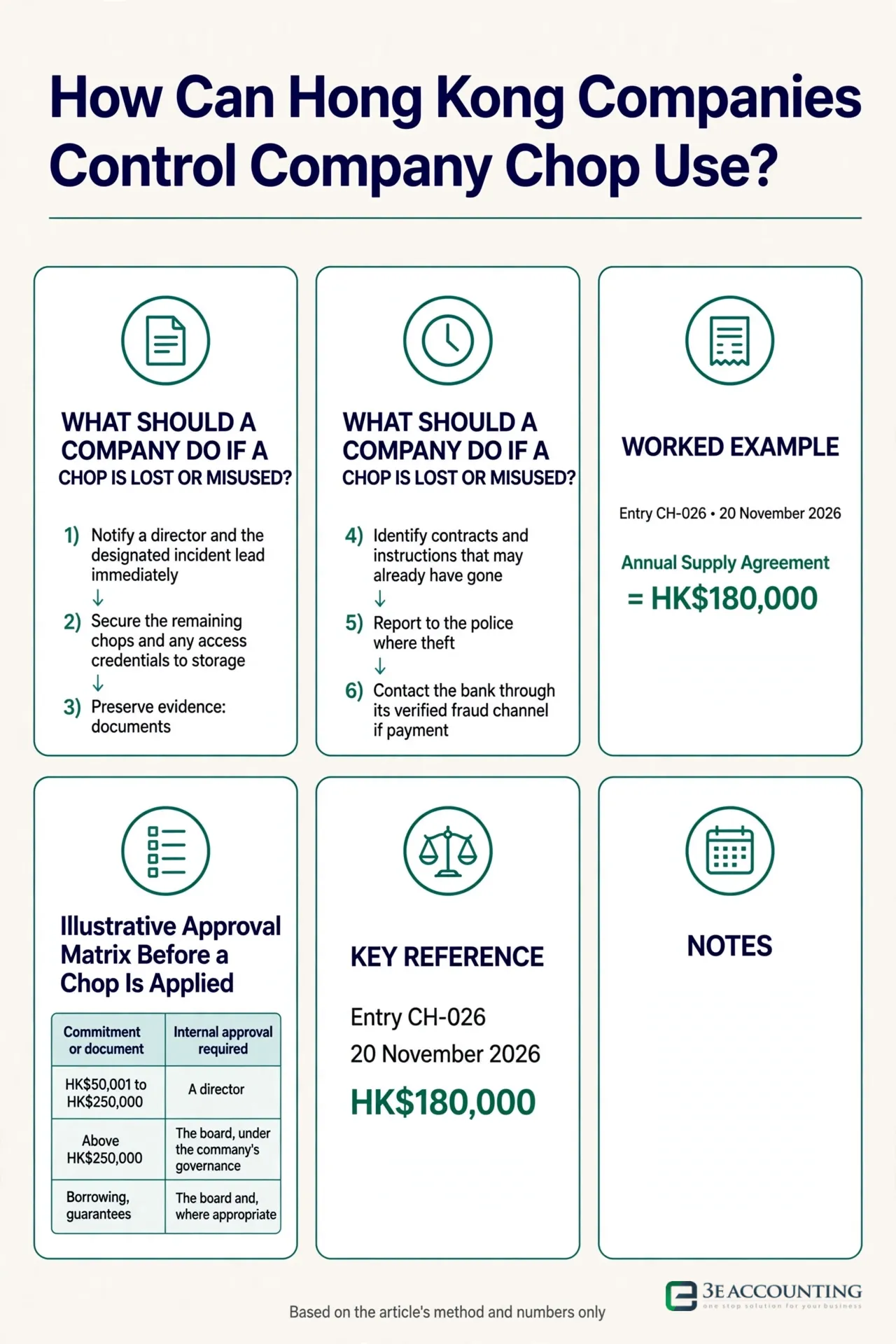
A purely hypothetical entry shows the idea. Entry CH-026, dated 20 November 2026, records a Hong Kong trading company's annual supply agreement at HK$180,000. Director approval is attached, and an authorised manager signs. Two originals are released and the scanned signed copy is retained. Every element answers the one question a chop cannot.
A practical design reconciles the register against stored documents monthly. It also includes a periodic access review of keys, approvals and delegations. Frequencies are chosen by the company, not imposed by law. Because the register captures personal data such as names, signatures and identity details, review collection and retention against Hong Kong privacy requirements before rolling it out.
How Should a Company Approve Each Chop Application?
Approve against total committed exposure — the whole contract term, not the first invoice — and escalate defined document types regardless of value.
The matrix in the table below is an illustrative internal control design for an ordinary trading company. The monetary bands are control thresholds, not statutory limits. A live matrix must follow the company's governance documents, articles and contractual risk profile. The company should define how its adopted matrix handles amounts between the stated whole-dollar thresholds.
The custodian checks evidence of approval but does not become the commercial approver. Accountability for the commitment stays with the approver; the custodian simply confirms that the right person signed off before the chop is applied.
Approval thresholds also sit alongside legal requirements. Board approval does not displace any necessary shareholder approval or other legal formality, and each application should record separately who signs and how the document is executed.
1. Measure the total commitment
Approve against total committed exposure over the contract term, including minimum purchase volumes, rather than the first invoice. A written anti-splitting rule stops one commitment being dressed up as several small ones.
2. Escalate by document type
Borrowing, guarantees, security, related-party transactions, property commitments, deeds and material departures from standard terms go to the board, and where appropriate legal review, regardless of value.
3. Keep internal approval separate from the counterparty's authority
Approving our purchase says nothing about the supplier manager's authority to bind the supplier, and their chop does not fill that gap. Proportionate evidence of their mandate, and the correct execution method on their side, remain separate checks.
Illustrative Approval Matrix Before a Chop Is Applied
| Commitment or document | Internal approval required |
|---|---|
| Routine purchases or sales up to HK$50,000, within an approved budget and on approved terms | Relevant department head |
| HK$50,001 to HK$250,000 | A director |
| Above HK$250,000 | The board, under the company's governance arrangements |
| Borrowing, guarantees, security, related-party transactions, property commitments, deeds and material departures from standard terms | The board and, where appropriate, legal review, regardless of value |
How Do You Verify a Counterparty's Signing Authority?
Start with the legal entity and the transaction, never the chop impression, and confirm any mandate through a contact reached independently.
A current Companies Registry search shows the exact company name, registration details, status and current directors — the same register consulted when registering a company in Hong Kong. Compare those particulars with the contract and the Business Registration Certificate before anything else.
Two boundaries matter. First, the search is an identity and background check; it does not by itself establish that a particular manager holds authority for the transaction. Second, a Business Registration Certificate evidences business registration with the Inland Revenue Department; it is not evidence that the person signing can bind the company.
For a manager signing an ordinary contract, request a transaction-specific authorisation or an applicable delegation, then confirm it through a director or an established authorised contact reached independently. A board resolution is not necessarily the only possible evidence, but for material or unusual commitments it is prudent to insist on a resolution approving the transaction and naming the signatory. Where board powers, quorum or execution provisions are relevant, inspect the articles; for a power of attorney, verify its scope, execution and continuing validity. These are our working practices — the appropriate evidence depends on the transaction, and counsel should confirm the standard for any significant deal.
Identity checks deserve care. Record how the signer's identity and role were verified. Do not routinely retain a full Hong Kong Identity Card copy. Collection of ID card copies is restricted to circumstances permitted by the code published by the Privacy Commissioner for Personal Data. Necessity alone is not a blanket permission.
One instrument is often misunderstood. An apostille issued through the Hong Kong Judiciary authenticates specified features of a public document; it does not certify the document's contents. An apostille is not proof that a commercial signatory holds authority or that the transaction is valid. Cross-border, regulated, financing, property, deed and power-of-attorney matters may each need an entity-specific authority and execution review — take local advice before applying this general approach to them.
The red flags below are practical risk indicators, not proof of fraud or invalidity. The right response is to pause, escalate and complete the authority checks.
1. Mismatched entities
The contracting party's name differs from registry particulars or the Business Registration Certificate, or the group letterhead does not match the legal entity.
2. Inadequate or lapsed authority
An expired delegation, vague wording, or a resolution that does not name this transaction or this signatory.
3. Refusal of independent confirmation
Contacts insist the chop alone suffices and resist a call to a registered director or an established contact.
4. Pressure to sign incomplete documents
Blanks or missing schedules leave the final commitment unclear. Pause if someone pressures you to sign before completing them, even when the deadline feels urgent.
5. Unusual payment instructions
Personal-account details or last-minute payment redirection away from the counterparty warrant scrutiny. Verify changes independently before proceeding, and escalate unexplained instructions.
Counterparty Authority Evidence: What It Shows and Does Not
| Evidence | What it can show | What it does not show |
|---|---|---|
| Companies Registry search | Company particulars, status and current directors | A particular manager's authority for this transaction |
| Business Registration Certificate | Current business registration | That the signer can bind the company |
| Delegation or transaction-specific authorisation | A mandate covering this contract or role | Its own authenticity, without independent confirmation |
| Board resolution | Approval of the transaction and a named signatory | Anything about contracts outside its stated scope |
| Articles of association | Board powers, quorum and execution provisions | Transaction-specific approval, on their own |
What Should a Company Do If a Chop Is Lost or Misused?
Treat the event first as an authority and fraud incident: notify a director immediately, suspend the affected chop and preserve the evidence.
The sequence below is an illustrative response pattern our team suggests for incident procedures. Confirm the responsible roles and notification duties for the specific company, and take legal advice where commitments are disputed.
- Notify a director and the designated incident lead immediately, and suspend use of the affected chop.
- Secure the remaining chops and any access credentials to storage.
- Preserve evidence: documents, access logs, correspondence and CCTV footage.
- Identify contracts and instructions that may already have gone out under the chop.
- Report to the police where theft, forgery or fraud is suspected, and keep the reference.
- Contact the bank through its verified fraud channel if payment instructions or mandates may be affected.
- Notify affected counterparties through verified contacts, describing accurately what is disputed — without asserting that every chopped document is automatically void.
- Record the facts in the appropriate board process, suspend or revoke affected delegations and approve replacement arrangements.
Timing and tone matter afterwards. Replacing the chop, or revoking a delegation, does not retrospectively erase an earlier commitment. It may not protect the company against a third party who had no notice of the change. Counsel should review the notification wording and advise on any disputed liability.
Two housekeeping points finish the response. We are not aware of a routine Companies Registry cancellation filing for a lost ordinary rubber chop. Ask counsel to confirm whether any filing applies. If the lost item is a statutory common seal, check the articles and take advice on replacement and execution. Separately, whether any affected document must be stamped or registered depends on its subject matter. Inland Revenue Department guidance lists the chargeable document categories. It never depends on the presence of a chop.
Conclusion
Hong Kong company chop control comes down to four separations:
- custody from approval
- approval from signing
- the company's own authority from the counterparty's
- the chop itself from the documents it touches The law allows execution without any seal, so a chop is best treated as a risk to manage rather than a formality to trust.
As a Corporate Services Provider, 3E Accounting Hong Kong provides corporate secretarial services. Our team can discuss controls such as chop policies, custody-and-use registers and approval matrices. Confirm the scope of any services, including physical custody or register administration, in the engagement. Commercial approval stays with the company's authorised decision-makers.
If a disputed impression or an unclear mandate keeps resurfacing in your contracts, discuss your control needs with our corporate secretarial team.
Get Your Chop Controls Reviewed
Discuss your chop policy, use register and counterparty authority checks with our corporate secretarial team. Confirm the scope of services before engagement.
Frequently Asked Questions
No. Under the Companies Ordinance (Cap. 622) a common seal is optional, and a company can execute documents under section 127 without one. An ordinary contract can also bind a company through a person acting with its authority, so the chop is a commercial convention rather than a validity requirement.
No. Possession of the chop is not authority, and an internal limit does not by itself settle whether the company is bound. Require approval records and mandate evidence, and take legal advice where an unauthorised use has occurred.
At minimum: entry number, request and application dates, the entity and chop identifier, the final document and its version, the purpose, the total commitment, the approver and approval reference, the signatory and authority evidence, the person applying the chop, the number of originals, the delivery record and the return-to-storage confirmation. Review personal-data handling before use.
Notify a director and suspend use of the chop immediately, then secure the remaining chops, preserve evidence and identify what has already gone out. Report to the police where theft or forgery is suspected, contact the bank through its verified fraud channel if payments may be affected, and record the facts in a board process before arranging a replacement.
We provide corporate secretarial services. Discuss your needs with our team and confirm the scope of any services in the engagement. Do not assume physical custody or register administration is included. Commercial approval stays with the company's authorised decision-makers.

Abigail Yu
Director
Abigail Yu oversees executive leadership at 3E Accounting Group, leading operations, IT solutions, public relations, and digital marketing to drive business success. She holds an honors degree in Communication and New Media from the National University of Singapore and is highly skilled in crisis management, financial communication, and corporate communications.