When a founder pays startup bills personally or sends cash into a Hong Kong company, the first question is whether the company owes that money back. A bank reference alone does not determine the classification of founder funding for a Hong Kong company.
In this blog, we explain the general decision points behind reimbursement, shareholder loans, share capital and other owner contributions, together with the supporting records and Hong Kong filing considerations. The discussion presents general professional judgement, not a confirmed 3E Accounting Hong Kong intake procedure; the legal terms, evidence and applicable reporting framework must be assessed for the particular facts.
As general guidance, identify who paid, what the payment funded and whether the company has a repayment obligation before choosing a classification.
Classify the payment by its legal and economic substance, not by the bank narration. This is general professional judgement rather than a confirmed 3E Accounting Hong Kong procedure. The final classification depends on reliable supplier evidence, proof of payment, business purpose, enforceable terms and the applicable reporting framework.
Three questions make the first cut:
- Did the founder settle a liability the company itself owed?
- Did cash actually enter the company's bank account?
- What are the terms: repayable, subscribed, or irrevocable?
The facts that can change the result include enforceable repayment terms, an effective allotment or a documented irrevocable contribution made in an owner capacity. An intention to leave money in the company does not by itself settle a debt, and a spreadsheet label does not turn a repayable advance into capital.
Personal spending, payments by a non-shareholder director and pre-incorporation costs need separate analysis. For an unexplained founder receipt, a temporary clearing account while evidence is gathered is a prudent interim control, not a final income or equity classification. The examples and comparison tables in this guide are general illustrations, not confirmed client files, controlled procedures or universal outcomes.
1. Expense reimbursement
A founder who personally settles a genuine company cost creates a payable, not new equity. The company recognises the underlying expense, asset or prepayment, plus an amount due to the founder. Reimbursement later clears that payable; it is not a separate funding class.
2. Shareholder loan
Cash received under genuinely repayable terms is a shareholder loan and sits in liabilities at the repayable amount. Written terms, not the bank narration, are the test. Interest-free, repayable-on-demand structures are common in the first year, but they still need documentation.
3. Share capital
Share capital requires an actual subscription for shares and an effective allotment. A subscription received before allotment must be examined on its own terms. Until the allotment is complete, the amount does not automatically sit in equity.
4. Owner contribution reserve
A documented, irrevocable contribution by a founder acting as owner — with no shares issued and no repayment right — may support an equity contribution reserve. Such a reserve is not freely withdrawable. Its presentation depends on the applicable reporting framework.
How Do the Three Routes Look on a First-Year Balance Sheet?
One injection, three balance sheets: a repayable liability, stated capital, or a payable that reimbursement simply clears.
Take a deliberately simple hypothetical: a newly formed company, HK$300,000 of services consumed in year one, no tax effects and an otherwise empty balance sheet. The figures are illustrative only. They show general mechanics rather than any client result, and presentation and measurement must be confirmed under the reporting framework selected for the company.
Route A — a shareholder loan. The founder wires HK$300,000 under signed, interest-free, repayable-on-demand terms.
- On receipt: debit bank HK$300,000; credit shareholder loan HK$300,000.
- After spending: no cash, a HK$300,000 shareholder liability, and accumulated losses of HK$300,000.
- A later repayment would debit the loan, not expenses. The profit and loss account would not record a second expense.
Route B — share capital. The founder subscribes for new shares, the allotment becomes effective, and the money arrives.
- On receipt: debit bank HK$300,000; credit share capital HK$300,000.
- After spending: share capital of HK$300,000 offset by accumulated losses of HK$300,000, with no shareholder debt.
- Any later return of capital needs an applicable lawful company-law route rather than a transfer labelled repayment.
Route C — the founder pays suppliers directly. No cash enters the company's account.
- On the costs: debit expenses HK$300,000; credit amount due to founder HK$300,000.
- After spending: the balance sheet matches Route A — no cash, a HK$300,000 payable, and accumulated losses.
- Reimbursement later clears the payable and does not create a second expense.
One distinction matters: cash sent so that the company can pay suppliers is an advance or subscription, not reimbursement. Hong Kong local companies with share capital operate under a no-par-value regime, so a current allotment should not be presented as creating a new share-premium account.
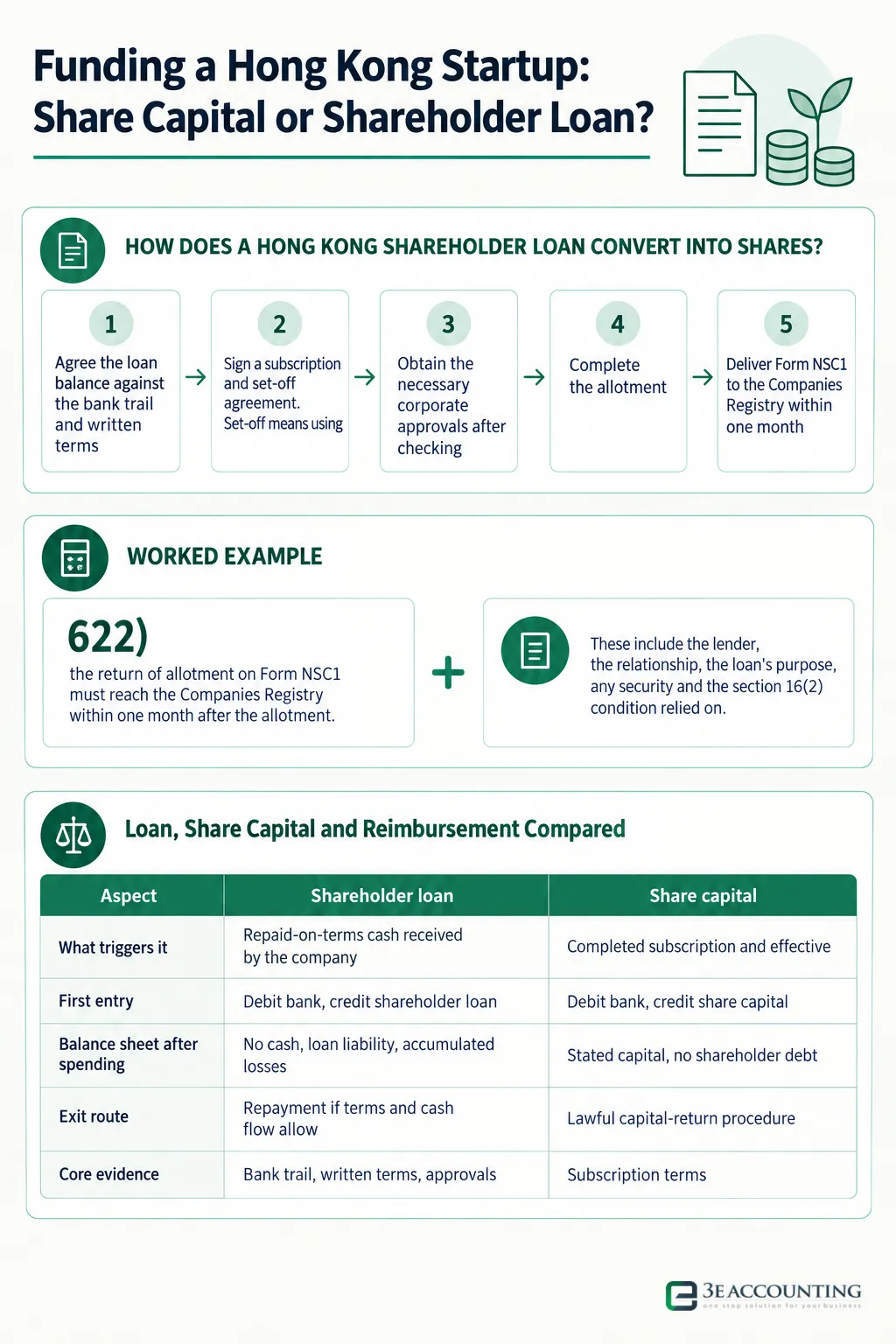
| Aspect | Shareholder loan | Share capital | Expense reimbursement |
|---|---|---|---|
| What triggers it | Repaid-on-terms cash received by the company | Completed subscription and effective allotment | Founder personally settles a company cost |
| First entry | Debit bank, credit shareholder loan | Debit bank, credit share capital | Debit expense or prepayment, credit amount due to founder |
| Balance sheet after spending | No cash, loan liability, accumulated losses | Stated capital, no shareholder debt | No cash, founder payable, accumulated losses |
| Exit route | Repayment if terms and cash flow allow | Lawful capital-return procedure | Reimbursement clears the payable |
| Core evidence | Bank trail, written terms, approvals | Subscription terms, resolutions, register, Form NSC1 | Supplier invoices, proof of founder payment, purpose |
Which Documents Must Back Each Funding Decision?
Each route stands on paper: written terms for a loan, completed allotment records for capital, and supplier evidence plus proof of payment for reimbursement.
Under the Companies Ordinance (Cap. 622), the return of allotment on Form NSC1 must reach the Companies Registry within one month after the allotment. Filing the form alone does not cure a defective subscription or allotment; the underlying records must stand on their own. The same ordinance confirms that Hong Kong shares carry no par value, so a current allotment does not create a share premium account.
Clients who engage our Hong Kong company incorporation services usually settle funding terms in the same early weeks, and the sequence is sound: money recorded correctly once avoids reclassification later. Founders still weighing why set up a company in Hong Kong should plan the funding route in parallel, because the two decisions interact.
Missing evidence never justifies omitting a real transaction. Book the facts the papers support, flag the unresolved classification, and obtain confirmations. Personal costs are rejected as company expenses, and duplicate reimbursement claims are refused outright. A repayable advance stays a liability until an effective allotment or release changes its nature — never backdate an equity entry to tidy a ledger.
1. For a shareholder loan
Keep the remitter's identity, bank evidence and a reconciliation to the amount received. Record written terms covering currency, interest, maturity, repayment and any subordination or security, plus the relevant corporate approval and directors' interest disclosure. A signed balance confirmation corroborates; it does not substitute for understanding the transaction.
2. For share capital
Obtain the subscription or conversion agreement, and check the articles and any shareholders' agreement for restrictions. Evidence the approvals, allotment details, updated register of members and share-certificate records, plus the NSC1 filing. For a non-cash conversion, also agree the loan balance and an effective set-off or release mechanism.
3. For reimbursement
Require an itemised claim, supplier invoices or equivalent reliable evidence, proof that the founder paid, and a business-purpose explanation. Approval should sit with an appropriate person other than the claimant. Check whether the item is an expense, asset or prepayment; incorporation expenditure is not automatically deductible for tax.
The loan remains a liability until the debt is effectively discharged and the allotment steps are legally complete — then, and only then, does it become share capital.
A conversion of a Hong Kong shareholder loan into shares is a sequence, not a single journal entry. As a general control point, the balance should remain a liability until the debt is effectively discharged and the share-allotment steps are legally complete. Legal and company-secretarial review is needed for the set-off, corporate authority, registers and filings.
- Agree the loan balance against the bank trail and written terms.
- Sign a subscription and set-off agreement. Set-off means using one obligation to settle another, so the subscription price is applied against the agreed loan balance.
- Obtain the necessary corporate approvals after checking the articles and any shareholders' agreement.
- Complete the allotment, update the register of members and issue any required share certificates.
- Deliver Form NSC1 to the Companies Registry within one month after the allotment.
Once the debt has been effectively discharged and the allotment is complete, the balance may be recorded as share capital under the applicable reporting framework. A founder should not assume an amount converted into share capital can later be withdrawn as a loan repayment. The facts, company documents and lawful capital-return route require review.
Evidence Checklist for Founder Funding Routes
| Route | Documents practitioners look for | Red flags |
|---|---|---|
| Shareholder loan | Bank trail, remitter identity, written terms (currency, interest, maturity, repayment, subordination), corporate approval, directors' interest disclosure | No written terms; balance cannot be reconciled to the bank trail |
| Share capital | Subscription or conversion agreement, articles and shareholder-agreement checks, approvals, allotment details, updated register of members, share certificates, evidence of NSC1 filing | No allotment records; subscription money booked as capital before allotment |
| Expense reimbursement | Itemised claim, supplier invoices or equivalent evidence, proof the founder paid, business purpose, approval by someone other than the claimant | Personal costs submitted; duplicate claims; missing proof of payment |
| Owner contribution reserve | Irrevocable written terms, no repayment right, no shares issued, approval and legal review | Reserve created only to reclassify a repayable advance |
When Can a Founder Lawfully Take Money Back Out?
Money leaves a Hong Kong company through a genuine repayment, an effective waiver, or a lawful capital-return or distribution process — never through an informal transfer.
None of these routes is a do-it-yourself exercise, and the first year creates no exemption from any of them. Each carries related-party disclosure consequences beside the legal test. Where solvency is in question, contact us before any insider payment moves.
1. Repaying a genuine shareholder loan
A genuine shareholder loan may be repaid where its terms permit, the balance is substantiated and the payment is properly authorised and supported. Before an insider payment, the company should consider whether cash-flow or solvency concerns, security, subordination, financing covenants or other restrictions require legal advice. A payment close to year-end does not remove any disclosures required by the applicable reporting framework.
2. Waiving or writing off a loan
A company cannot simply remove a debt it owes to a founder by posting a unilateral write-off. An effective release is needed, followed by separate analysis of the accounting and tax consequences. Whether a waiver represents an owner contribution or another treatment depends on the facts, and legal confirmation of the release plus tax-specialist review should be obtained.
3. Returning share capital
Paid-up capital should not be treated as an ordinary repayable shareholder loan. Under the court-free capital-reduction route in the Companies Ordinance (Cap. 622), all directors make a solvency statement, the company passes a special resolution, statutory notices and filings apply, and creditors or members may have a challenge period. The reduction takes effect when Form NSC19 is registered, not when a journal is posted. This is not the only possible capital-return route, so Hong Kong legal and company-secretarial review is essential.
Exit Routes From Founder Balances and Their Preconditions
| Exit route | What must be in place | Consequence if skipped |
|---|---|---|
| Repay a shareholder loan | Terms permit repayment, substantiated balance, proper authorisation, cash-flow solvency, no covenant or insolvency restriction | Insider repayment may be challenged as an unfair preference where statutory conditions are met |
| Waive a loan | Effective release by the founder, not a unilateral company write-off; tax analysis of the facts | Balance stays payable; tax treatment resolved incorrectly |
| Reduce share capital | Directors' solvency statement, special resolution, statutory notices, creditor challenge period, registration of the return (Form NSC19) | No effective reduction; exposure for unlawful returns of capital |
| Distribute reserves | A lawful distribution route, solvency review and legal review of the articles | Unlawful or challengeable distribution |
Which Tax and Registry Points Do Founders Overlook?
Interest deductibility, charge registration and the reporting framework all follow the classification — so a wrong label costs twice.
Interest on a shareholder loan is never automatically deductible. Guidance accompanying the profits tax return issued by the Inland Revenue Department asks related-party interest claims to identify several details. These include the lender, the relationship, the loan's purpose, any security and the section 16(2) condition relied on. Interest-bearing or cross-border founder loans therefore warrant specialist tax analysis. Deductibility, the lender's own tax position and any overseas withholding consequences are three separate questions.
Security raises its own filing. If a loan's security arrangement creates a registrable charge over company assets, the relevant instrument and Form NM1 generally must be delivered for registration within one month after creation. Registrability turns on the instrument's substance, not its title — a solicitor should make that call.
Two further points deserve attention. First, the SME-FRF and SME-FRS reporting framework has its own eligibility tests. The Hong Kong Institute of Certified Public Accountants (HKICPA) publishes these standards. A founder should not assume every startup qualifies. Second, most private companies file audited financial statements annually. The annual return is due each year. The Companies Registry's current fee schedule charges HK$105 where the return is delivered within 42 days after the return date. It rises in steps after that. Where founders also draw salaries, the salaries tax side sits with our individual personal income tax services in Hong Kong, handled separately from any loan repayment.
Conclusion
Founder funding should be classified by substance before it is recorded. A genuine company cost paid personally may create a payable. Cash advanced on repayable terms may be a shareholder loan. A completed subscription and effective allotment may support share capital. The documents and legal steps matter as much as the journal entry.
3E Accounting Hong Kong can help founders organise the payment trail and supporting records, and coordinate the relevant company-secretarial, tax, legal and reporting considerations. The final classification, documentation and filing requirements should be confirmed against the company's specific facts before action is taken.
If you are planning a first injection or reviewing an amount already transferred, contact 3E Accounting Hong Kong to discuss the documents and questions that need to be addressed.
Get Your Founder Funding Classified Correctly
Tell us how funds entered or were spent for your Hong Kong company, and we can help identify the records and specialist reviews needed before the amount is classified.
Frequently Asked Questions
Not from the label alone. As general guidance, share capital requires an actual subscription and effective allotment, and Form NSC1 must be delivered to the Companies Registry within one month after the allotment. The subscription terms and corporate records still need to support the treatment.
A repayment may be possible if the loan terms permit it, the balance is substantiated and the payment is properly authorised and supported. Where the company has cash-flow or solvency concerns, obtain Hong Kong legal advice before an insider payment.
The company should not simply remove a debt it owes to the founder through a unilateral entry. An effective release is required, followed by separate consideration of the facts, the reporting treatment and the tax consequences.
Generally, paid-up share capital is not returned through an ordinary loan repayment. A capital reduction or another lawful route may be required, and the appropriate process depends on the company's facts, articles and transaction structure.
A founder loan does not automatically create a Companies Registry filing. If security over company assets creates a registrable charge, the relevant instrument and Form NM1 generally must be delivered for registration within one month after the charge is created. A solicitor should confirm whether the security is registrable.

Abigail Yu
Director
Abigail Yu oversees executive leadership at 3E Accounting Group, leading operations, IT solutions, public relations, and digital marketing to drive business success. She holds an honors degree in Communication and New Media from the National University of Singapore and is highly skilled in crisis management, financial communication, and corporate communications.