Electronic filings can incorporate and register a Hong Kong private company limited by shares in roughly one hour. If you register as a sole proprietor instead, it is worth understanding upfront what taxes freelancers and sole proprietors pay in Hong Kong. Speed of setup, however, is only the beginning of the financial discipline a startup needs.
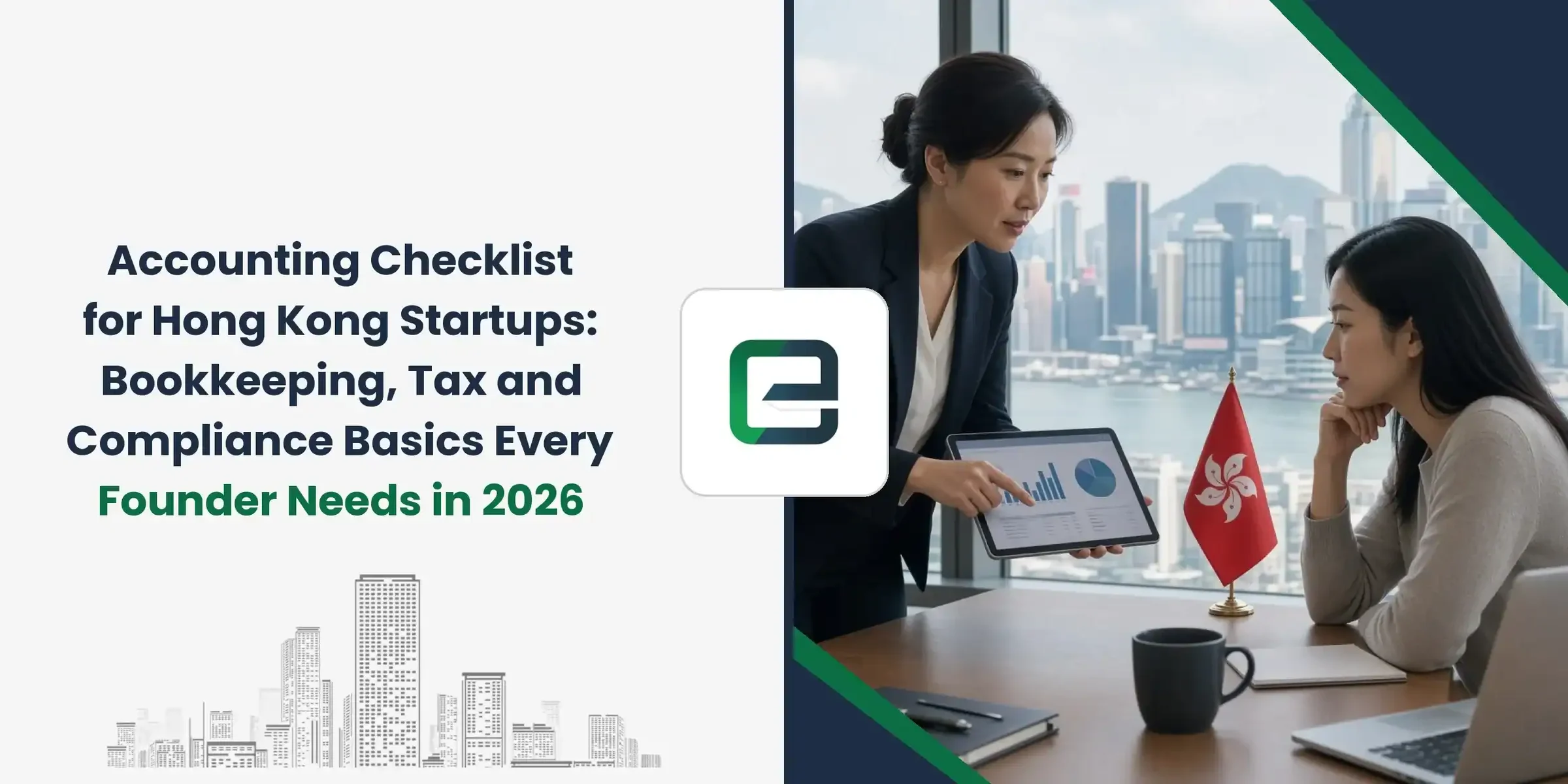
In this blog, we discuss bookkeeping, tax and compliance fundamentals for Hong Kong founders in 2026. It covers incorporation fees, profits tax rates, audit requirements, annual filings and record-keeping habits. It is just as important to understand which accounting mistakes Hong Kong SMEs should avoid, since small bookkeeping errors can grow into costly compliance problems.
What Setup Choices Determine Your Accounting Obligations From Day One?
The company form, filing channel and business registration completed at incorporation fix your fees, tax rate and compliance calendar from day one.
Fintech ventures, cafés and accounting practices in Hong Kong follow the same financial rules. Those rules govern their books and filings.
A Hong Kong startup incorporated as a company is registered with the Companies Registry, while sole proprietorships and partnerships register under the Business Registration Ordinance. A company limited by shares is the default vehicle for most startups, while a company limited by guarantee suits non-profit structures.
Under the one-stop company and business registration service, founders submit incorporation documents to the Companies Registry, which treats the application as a simultaneous application for business registration with the Inland Revenue Department. Form NNC1 applies to companies limited by shares, while Form NNC1G applies to guarantee companies. Founders also submit the articles, a Notice to the Business Registration Office (IRBR1), and the prescribed business registration fee and levy.
Filing electronically through the e-Services Portal costs HK$1,545 for a company with share capital, against HK$1,720 for the hard-copy route. The electronic channel is also faster. A private company limited by shares typically receives its Certificate of Incorporation and Business Registration Certificate within about one hour of electronic delivery, while hard-copy applications take around four working days.
A company limited by guarantee is assessed differently. Its registration fee scales with the number of members, ranging from HK$155 for 25 members or fewer up to a cap of HK$925 for electronic applications. Certificates for guarantee companies generally issue in about three weeks.
Founders comparing providers often begin with our Hong Kong company incorporation services to streamline this stage. A full breakdown of how long it takes to register a company in Hong Kong, from start to finish, is available in a separate guide on our site.
Incorporation Fees and Timelines in Hong Kong (2026)
| Item | Electronic filing | Hard-copy filing |
|---|---|---|
| Application fee (company with share capital) | HK$1,545 | HK$1,720 |
| Certificate issuance (private company limited by shares) | About 1 hour | About 4 working days |
| Registration fee (company limited by guarantee) | HK$155 to HK$925 by member count | HK$170 to HK$1,025 by member count |
| Certificate issuance (company limited by guarantee) | About 3 weeks | About 3 weeks |
Which Bookkeeping Fundamentals Should Every Founder Establish Early?
Five fundamentals matter most: a separate business bank account, a simple chart of accounts, a monthly close, seven-year record retention and cloud accounting software.
Good bookkeeping is not an administrative afterthought. The Inland Revenue Ordinance requires businesses to keep sufficient records in English or Chinese. They must retain those records for at least seven years. Messy books often cause Hong Kong startups to struggle with tax filings and audit work. The following practices form a reliable baseline for a young company.
1. Separate the business bank account from personal funds
Commingling personal and business transactions destroys the audit trail and weakens limited liability protection. Open a dedicated corporate account immediately after incorporation and route every transaction through it.
2. Build a simple chart of accounts
A lean chart of accounts covering revenue, cost of sales, operating expenses, assets and liabilities keeps classification consistent. Resist creating dozens of accounts before the business needs them.
3. Run a monthly close
Reconcile bank accounts, post accruals and review a profit and loss statement every month. A monthly close surfaces problems while they are still small and makes year-end work far cheaper.
4. Retain records for at least seven years
Keep invoices, contracts, bank statements and payroll records for a minimum of seven years. The Inland Revenue Department (IRD) can disallow deductions where supporting records are missing.
5. Adopt cloud accounting software
Cloud platforms with multi-currency support match Hong Kong's trading environment and allow a Corporate Services Provider to access the ledger remotely. Digital records also satisfy the Companies Ordinance's requirements for accounting records kept at the registered office or designated place.
What Tax Obligations Apply to Hong Kong Startups in 2026?
Corporations pay profits tax at 16.5%, with the first HK$2 million of assessable profits taxed at 8.25% under the two-tiered regime.
Hong Kong taxes territorial profits, not worldwide income, which is why the jurisdiction remains attractive for regional startups. According to the Inland Revenue Department, the year of assessment runs to 31 March. Corporations pay profits tax at 16.5%, while unincorporated businesses pay 15%. Since the 2018/19 year of assessment, the two-tiered regime halves the rate on the first HK$2 million of assessable profits. It charges 8.25% for corporations and 7.5% for unincorporated businesses.
Timing matters for new companies. A newly incorporated company typically receives its first Profits Tax return about 18 months after its incorporation date, although the IRD may issue a provisional return earlier. Subsequent returns are issued each April and must be filed within the stated deadline, which varies by filing method. A company incorporated on or after a given date is normally taxed from that date, so early revenue decisions have direct tax consequences.
Employer obligations run in parallel. Businesses must notify the IRD within three months after the commencement of employment for a new employee who is likely to be chargeable to Salaries Tax, and file employer's returns each April. Business registration itself must be renewed, either annually or every three years, through the Business Registration Office.
Founders should also confirm their tax identification number early, since it appears on returns, business registration documents and correspondence with the IRD. Our separate guide explains what a tax identification number is in Hong Kong and how to locate yours.
Profits Tax Rates for Hong Kong Businesses (2026/27 Year of Assessment)
| Business type | Standard rate | First HK$2 million of assessable profits |
|---|---|---|
| Corporations | 16.5% | 8.25% |
| Unincorporated businesses | 15% | 7.5% |
How Do Audits, Annual Returns and the AGM Fit Into the Compliance Calendar?
Private companies generally need an AGM, Form NAR1 and audited financial statements; reporting exemption only simplifies reporting.
The Companies Ordinance (Cap. 622) drives the annual cycle. Private companies must generally hold an annual general meeting within nine months after the end of their accounting reference period. Some companies may dispense with an AGM when statutory conditions are met.
Unless it has properly declared dormancy under section 5 of the Companies Ordinance, a private company must file Form NAR1 within 42 days after its incorporation anniversary, except in its incorporation year. That deadline does not run from the AGM. Late filing attracts penalties, so founders should track both dates independently.
A small private company may qualify for reporting exemption by meeting two of three size thresholds. Those thresholds are annual revenue of at most HK$100 million, total assets at most HK$100 million and no more than 100 employees. Reporting exemption allows simplified financial and directors' reports. It does not remove the audit requirement. Under the Companies Ordinance, an audit is still required except for dormant companies. The IRD generally requires Hong Kong-incorporated corporations to submit audited financial statements with Profits Tax returns.
Payroll adds another obligation. Except for exempt persons, employers must enrol eligible full-time and part-time employees aged 18 to 64 within the first 60 days of employment; the first contribution is due by the next contribution day after the month in which the 60th day falls. Missing this window triggers surcharges and can complicate future financing.
Annual Compliance Calendar for a Hong Kong Startup
| Obligation | Authority | Typical timing |
|---|---|---|
| Business registration renewal | Inland Revenue Department | Annually or every 3 years |
| Annual general meeting | Companies Registry rules | Within 9 months after the accounting reference period for a private company that is not a subsidiary of a public company; otherwise within 6 months, unless exempted or dispensed with, and subject to special first-period rules. |
| Annual return (Form NAR1) | Companies Registry | Within 42 days after the incorporation anniversary, except in the incorporation year and while a qualified private company has properly declared dormancy |
| Profits Tax return | Inland Revenue Department | Issued each April; first return about 18 months after commencement |
| MPF enrolment and first contribution | MPF authority | Within 60 days of an employee's first day |
Which Common Mistakes Should Startup Founders Avoid?
Five recurring mistakes cost Hong Kong startups the most: mixed funds, late registration renewals, missed MPF deadlines, late annual returns and inadequate records.
In practice, we see the same patterns repeat across early-stage companies, regardless of sector. Each mistake is avoidable with a simple calendar and disciplined record-keeping. An earlier article offering tips in accounting that young entrepreneurs in Hong Kong could use covers some of these habits in more depth, and the points below reflect what has changed since then.
1. Mixing personal and business funds
Directors paying company costs from personal cards create reconciliation backlogs that inflate bookkeeping fees and invite tax queries. Reimburse through the company account promptly instead.
2. Letting business registration lapse
Business registration certificates must be renewed annually or every three years. Trading on an expired certificate is an offence and can block banking and licence applications.
3. Overlooking MPF deadlines
The 60-day enrolment window for new employees is short. Startups scaling headcount quickly should assign MPF administration to a named owner or outsource it.
4. Filing annual returns late
The 42-day window after the incorporation anniversary closes quickly. Penalties escalate with each overdue return, and prolonged default can lead to prosecution or strike-off.
5. Letting records lapse
Missing invoices during a funding round or exit due diligence is costly. Retain full records for at least seven years, in line with IRD requirements.
When Does Outsourcing the Finance Function Make Sense for a Startup?
Most Hong Kong startups outsource bookkeeping, corporate secretarial work and tax filing until finance complexity justifies in-house hires.
A full-time finance hire rarely makes economic sense below sustained eight-figure revenue. Outsourcing to a Corporate Services Provider gives founders corporate secretarial support and management accounts. It also provides tax computation and audit coordination for a predictable monthly fee. Technology-enabled processes keep the ledger current in real time.
Founders researching how to start a coffee shop business in Hong Kong need an appropriate chart of accounts. It should include inventory and point-of-sale reconciliation. Software startups need revenue recognition and share option accounting from the outset. A provider that understands the business model sets up the books correctly the first time.
The practical test is simple. Consider outsourcing when one of the following occurs:
- Management accounts arrive more than ten working days after month-end.
- Tax deadlines are discovered rather than anticipated.
- The founder is the only person who understands the books.
At this point, engage Corporate Professional Advisors or a full-service provider.
Conclusion
A Hong Kong startup's financial obligations begin at incorporation and recur on an annual cycle. These include profits tax at 8.25% on the first HK$2 million of assessable profits and business registration renewal. They also include AGMs, annual returns and audited financial statements for non-dormant companies. Getting the bookkeeping fundamentals right in month one makes every later obligation cheaper and faster.
3E Accounting Hong Kong helps founders build that foundation from day one. Our incorporation, corporate secretarial, bookkeeping and tax filing services use technology-enabled processes. The 3E Accounting International Network spans more than 110 countries and supports founders around their schedules.
We tailor compliance packages for trading ventures, cafés and accounting practices in Hong Kong. They can match your stage and sector. Speak with us before the next filing deadline, not after it.
Get Your Startup's Accounting and Compliance on Track
3E Accounting Hong Kong provides incorporation, corporate secretarial, bookkeeping and tax support under one roof, with technology-enabled processes and a team reachable around the clock.
Frequently Asked Questions
A private company limited by shares that files its incorporation documents electronically through the e-Services Portal typically receives its Certificate of Incorporation and Business Registration Certificate within about one hour. Hard-copy applications take around four working days.
Corporations pay 16.5% profits tax, but the two-tiered regime lowers the rate to 8.25% on the first HK$2 million of assessable profits. Unincorporated businesses pay 15%, reduced to 7.5% on the first HK$2 million.
No. The Companies Ordinance reporting exemption may allow eligible small companies to prepare simplified reports. It does not waive audits. Audits are generally still required for Hong Kong companies, except dormant companies. The IRD also generally requires audited financial statements with corporate Profits Tax returns.
Businesses must keep sufficient records, in English or Chinese, for at least seven years under Inland Revenue Ordinance requirements. Missing records can lead to disallowed deductions and penalties.
Business registration certificates must be renewed annually or every three years through the Business Registration Office. Employers must enrol staff in an MPF scheme and make the first contribution within 60 days of an employee's first day of employment.

Abigail Yu
Director
Abigail Yu oversees executive leadership at 3E Accounting Group, leading operations, IT solutions, public relations, and digital marketing to drive business success. She holds an honors degree in Communication and New Media from the National University of Singapore and is highly skilled in crisis management, financial communication, and corporate communications.