

Hong Kong law creates no single entity called a nonprofit. Founders must choose an existing legal structure first, and that choice shapes governance, liability, funding and tax treatment.
In this article, we compare a company limited by guarantee with a registered society for a Hong Kong nonprofit setup. We also cover the Section 88 charity application, the real limits of its tax exemption, and how to prepare a nonprofit bank-account file.
Which Legal Form Should a Hong Kong Nonprofit Setup Choose?
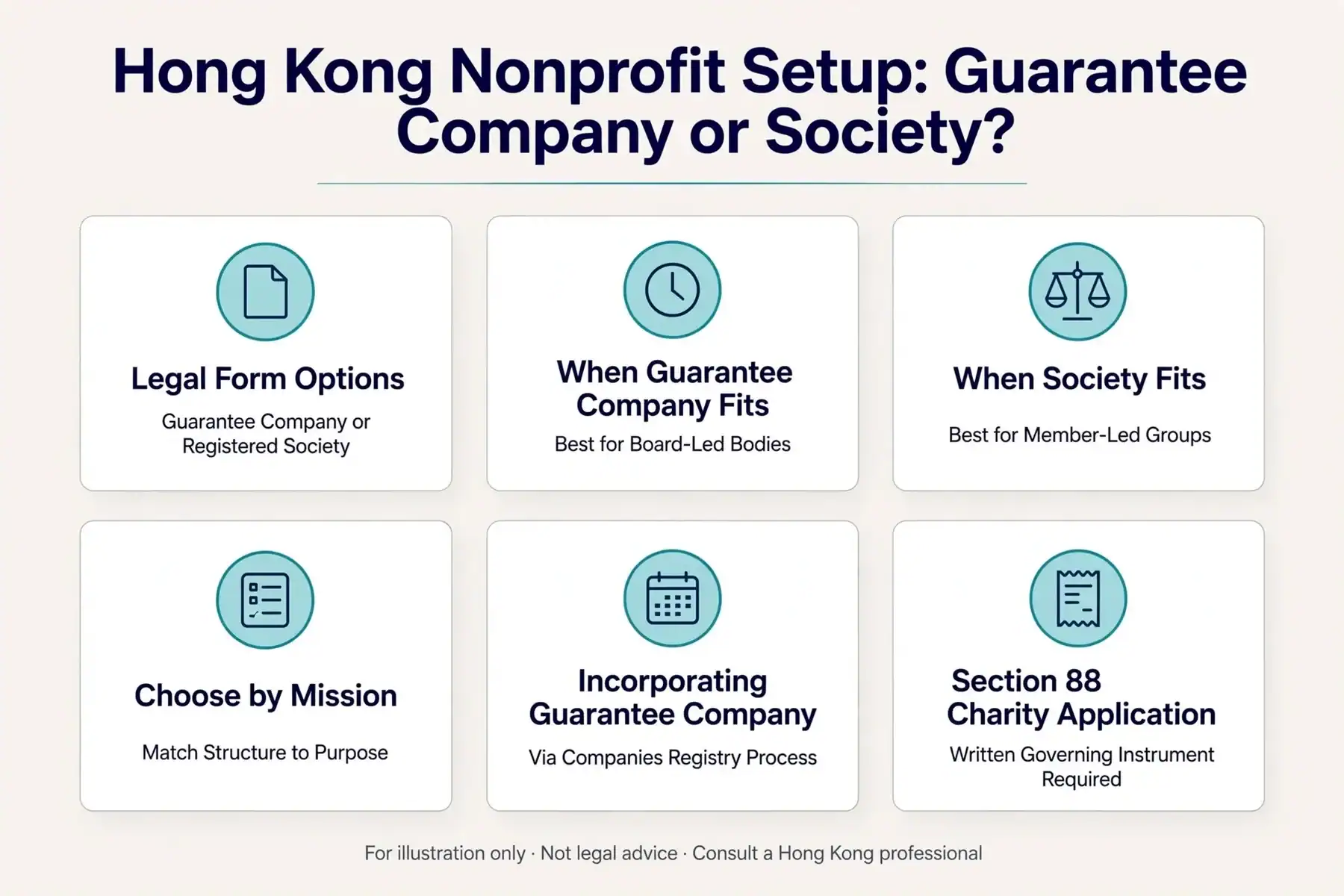
A company limited by guarantee and a registered society are the two main structures; the right one turns on governance, liability and funding — not on the word nonprofit.
Hong Kong statutes do not define a nonprofit organisation as a distinct legal form. The Hong Kong Police Force, which administers society registration, states that the Societies Ordinance does not define a non-profit-making organisation for registration purposes. The same guidance notes that organisations may choose the ordinance appropriate to their objects, nature and operation, and should seek legal advice on their own facts.
The Inland Revenue Department (IRD) treats structure and charitable status as separate questions. Section 88 recognition depends on charitable purposes, public character and how the organisation actually operates. It does not follow from the label nonprofit, nor from incorporation alone. The governing instrument follows the structure chosen: articles of association for a limited company, or a constitution for a society.
When Does a Company Limited by Guarantee Fit Better?
A guarantee company usually fits founders who want a board-led body that signs contracts, employs staff and receives formal grants.
This is a practical decision framework from our team's work with founders, not a legal rule. The Companies Ordinance caps each member's liability at the guarantee stated in the articles. That cap, together with formal governance, is what tends to attract grant-funded and staffed organisations. Founders on this route often begin with our Hong Kong company incorporation services.
1. Governance and limited liability
Members' liability is limited to the amount each undertakes to contribute if the company is wound up. The undertaking is not a share subscription, and it is not routinely payable while the company operates.
2. Contracts, employees and premises
Leases, employment contracts and service agreements can sit in the company's own name, so the company is ordinarily liable; directors and other office-bearers can still incur personal liability in particular circumstances.
3. Grant funding and overseas remittances
Grant-makers frequently require an incorporated counterparty before releasing funds. A guarantee company can also support the stronger financial controls that overseas grant programmes demand.
4. Accountability that funders recognise
Audited accounts and annual returns give funders a verifiable compliance record. In practice, that transparency supports donor and grant-maker due diligence.
When Is a Society Registration the Simpler Route?
A society suits a genuinely member-led, operationally simple local association with limited contractual exposure.
Societies register under the Societies Ordinance, administered by the Hong Kong Police Force. A local society generally applies for registration or exemption within one month of establishment, and the application is signed by three office-bearers. Registration is comparatively light, and committee roles typically change hands by member election.
Society registration does not, however, create charitable status or tax exemption. It also offers no statutory cap on office-bearers' exposure. Where an association later employs staff, leases premises or receives structured grants, its founders often revisit the structure question.
Guarantee Company versus Society Comparison
| Feature | Company Limited by Guarantee | Registered Society |
|---|---|---|
| Legal basis | Companies Ordinance incorporation via the Companies Registry | Registration or exemption under the Societies Ordinance |
| Governing instrument | Articles of association | Society constitution |
| Governing body | Board of directors plus a company secretary | Office-bearers; the application is signed by three office-bearers |
| Member liability | Limited to the undertaking in the articles, payable only on winding up | No equivalent statutory liability cap |
| Recurring reporting | Annual return with certified financial statements, directors' and auditors' reports | Notifications to the societies registry on specified changes |
| Typical fit | Board-led bodies that contract, employ staff or receive grants | Member-led, operationally simple local associations |
Which Structure Suits Different Missions?
The scenarios below are hypothetical composites offered as illustrations, not client matters.
Pattern recognition still helps founders decide. In our team's judgement, the deciding facts are usually governance preference, contracting needs, staffing, funding sources and trading activity — never Section 88 eligibility, which is structure-neutral.
1. A grant-funded education charity
A small self-perpetuating board, no mass membership and funders requiring an incorporated counterparty point to a guarantee company. Founders who first preferred a society often change course when funder requirements surface.
2. A member-run arts association
Annual committee elections, subscription income and small local sponsorships suggest a society. Low contractual exposure and volunteer operation keep the lighter structure workable.
3. An overseas-funded humanitarian body
Grant agreements, employed staff and cross-border remittances favour a guarantee company. The structure supports the controls that international funders expect to see.
4. A fee-charging training body
Paid courses, leased premises and employees create ongoing liabilities. A guarantee company ordinarily places contractual liabilities on the company, but does not eliminate personal liability for directors or other office-bearers in particular circumstances.
What Does Incorporating a Guarantee Company Involve?
Incorporation runs through the Companies Registry one-stop process: Form NNC1G, the articles and the IRBR1 business registration notice.
A guarantee company must have a company secretary and at least two directors. The articles must state each member's undertaking to contribute a specified amount if the company is wound up. Incorporation is deemed to include business registration, so the IRBR1 notice and the correct fee must accompany the application.
For 1 April 2026 to 31 March 2027, a one-year business registration certificate totals HK$2,350 — a HK$2,200 fee plus a HK$150 levy — per the IRD's Business Registration Fee and Levy Table. Since 1 October 2020, applications delivered electronically attract a 10% reduction in incorporation fees, excluding the business registration fee and levy. Certificates issued electronically or in hard copy carry the same legal effect.
Check current form versions, fees and filing methods immediately before submission, and start with a Hong Kong company name check. Overseas founders should also review the documents needed to incorporate a Hong Kong company as a non-resident.
Step 1: Clear the proposed name
Conduct an exact-name search, but registrability can be confirmed only after the Companies Registry processes the application; a name identical to one in the Registrar's index will be rejected.
Step 2: Draft the articles
Include properly restricted charitable objects if Section 88 will be pursued, plus income and property application, remuneration, amendment and dissolution provisions.
Step 3: File Form NNC1G with IRBR1
Deliver the incorporation form, the articles and the business registration notice with the correct fees. Electronic filing is available through the e-Services Portal.
Step 4: Hold the first board meeting
Adopt the registers, the bank mandate, the accounting reference date and officer appointments. Where an audit is required, make the appointment early.
How Does the Section 88 Charity Application Work?
Section 88 applicants need a written governing instrument with precise charitable objects, and must apply on the IRD's current Form C.D.22.
The IRD classifies charitable purposes under four heads: relief of poverty, advancement of education, advancement of religion, and other purposes beneficial to the community. Its Tax Guide for Charitable Institutions and Trusts of a Public Character also sets out the public-benefit and operational requirements. Listing a recognised head alone is not enough.
A written governing instrument is essential, with wording that states the charitable purposes precisely and includes the protective clauses the IRD's guidance identifies. Political purposes are not charitable. Activities that look political require fact-specific analysis of whether they are ancillary to genuine charitable purposes, so Hong Kong legal and tax review is prudent for advocacy or law-reform work.
The IRD endeavours to respond within four months of a complete application, provided no further information is required. That is a service standard, not an approval deadline. Incomplete applications are returned before processing, and the current Form C.D.22, with supplementary forms C.D.22A and C.D.22B, specifies the required documents. In our team's view, the pack should go beyond a mission statement and explain activities, beneficiaries, governance, funding and finances. This checklist is not exhaustive — use the IRD's current form, notes and charity guidance for any live application.
Section 88 Application Requirements
| Element | Position under IRD guidance |
|---|---|
| Governing instrument | Written articles or constitution stating precise charitable purposes with protective clauses |
| Charitable heads | Relief of poverty; advancement of education; advancement of religion; other purposes beneficial to the community |
| Application form | Form C.D.22, with supplementary forms C.D.22A and C.D.22B where applicable |
| Processing time | The IRD endeavours to respond within four months for complete applications |
| Political objects | Not charitable; potentially political activity needs fact-specific ancillary analysis |
| Trading income | Exempt only where the statutory proviso conditions are satisfied |
What Does Section 88 Tax Exemption Not Cover?
Recognition does not exempt all trading income, and gifts only become tax-deductible once recognition is granted.
The IRD states that profits from a charity's trade or business are exempt only where the statutory proviso conditions are satisfied. The profits must be applied solely to charitable purposes, must not be spent substantially outside Hong Kong, and the trade must be exercised in carrying out the charity's objects or mainly carried on by its beneficiaries. Applying commercial or fundraising profits to charitable objects, by itself, does not satisfy those conditions.
Donors are treated separately. Only qualifying monetary donations to an institution or trust exempt under Section 88, or to the Government for charitable purposes, count as approved charitable donations. The aggregate minimum is HK$100, and the deduction ceiling is 35% of assessable income or profits. Donor eligibility depends on each donor's own tax position.
An organisation may accept funds before recognition. It should not, however, represent those gifts as deductible approved charitable donations. Our conservative guidance is to have a Hong Kong tax specialist approve wording on receipts, fundraising materials and donor communications before use.
How Do You Open a Hong Kong Nonprofit Bank Account?
Banks apply their own KYC, sanctions and risk reviews to nonprofit accounts; no structure guarantees approval.
Requirements differ from bank to bank, and none are universal. A guarantee company is not automatically easier to bank, and Section 88 status does not improve approval odds — both points are bank-specific judgements. What a founder can control is preparation, which our team aligns around the account-opening resolution, a control chart, an activity description, funding evidence and an expected transaction profile.
Because expectations vary, founders can contact us to review a specific bank's current requirements before submitting a file.
Items commonly requested by banks include:
- Certificate of incorporation and a current business registration certificate
- The articles of association and an ownership or control chart
- A board resolution authorising account opening
- Identity and residential-address evidence for directors and signatories
- Source-of-funds details and expected transaction profiles
- An activity plan, budget, website or programme evidence
How does our team prepare a nonprofit account file?
- Align the account-opening resolution with the bank's mandate requirements
- Prepare a control chart before submission
- Match the activity description across the plan, budget and website
- Gather funding evidence, including donor or grant correspondence
- Set out expected overseas receipts and payments with explanations
What Compliance Follows After Incorporation?
A guarantee company files an annual return with audited financial statements, and renews business registration each year or every three years.
For a guarantee company, the annual return is due within 42 days after its return date, which falls nine months after the end of its accounting reference period. The return must include certified true copies of the financial statements, the directors' report and the auditors' report.
The Companies Registry requires an audit for all companies other than dormant companies, and no revenue threshold removes that obligation. Confirm dormant status and any special reporting question for the specific company. Deadlines and filing facts should always be checked against the company's actual financial year and circumstances.
Guarantee Company Compliance Calendar
| Obligation | Timing | What is filed |
|---|---|---|
| Annual return | Within 42 days after the return date, nine months after the accounting reference period ends | Certified true copies of financial statements, directors' report and auditors' report |
| Statutory audit | Each financial year, unless the company is dormant | Audited financial statements |
| Business registration renewal | Annually or every three years | Fee and levy per the IRD's current table |
Conclusion
The structure decision comes down to governance, liability and funding, not to the word nonprofit. A company limited by guarantee suits board-led bodies that contract, employ staff and receive grants. A society suits member-led, operationally simple associations. Section 88 then depends on charitable purposes, public character and actual operation, whichever structure is chosen.
We help clients weigh these factors, incorporate guarantee companies with Section 88-ready articles, prepare Section 88 application packs, and assemble nonprofit bank-account files. Where a society later needs a company structure, we also plan the transition — new incorporation, contract and asset arrangements, banking and any fresh Section 88 application — with Hong Kong legal review where it is required.
3E Accounting Hong Kong provides incorporation, corporate secretarial and tax advisory support so nonprofit founders can launch and operate with confidence.
Build Your Nonprofit on the Right Foundation
Compare structures, incorporate and pursue Section 88 recognition with a team that guides nonprofit founders in Hong Kong from name check to first annual return.
Frequently Asked Questions
No. The Hong Kong Police Force states that the Societies Ordinance does not define a non-profit-making organisation, and registration confers no charitable status. Tax exemption is a separate matter under Section 88.
Yes. The IRD accepts a society's constitution as the written governing instrument, and eligibility turns on charitable purposes, public character and actual operation — not on the legal structure chosen.
The IRD endeavours to respond within four months of a complete application, provided no further information is required. This is a service standard, not an approval deadline, and incomplete applications are returned before processing.
No. Profits from a trade or business are exempt only where the statutory proviso conditions are satisfied — profits applied solely to charitable purposes, not spent substantially outside Hong Kong, and trade tied to the charity's objects or beneficiaries.
An organisation may accept funds before recognition, but it should not represent those gifts as approved charitable donations eligible for a Hong Kong tax deduction. Only donations to Section 88-recognised institutions or the Government qualify.

Abigail Yu
Director
Abigail Yu oversees executive leadership at 3E Accounting Group, leading operations, IT solutions, public relations, and digital marketing to drive business success. She holds an honors degree in Communication and New Media from the National University of Singapore and is highly skilled in crisis management, financial communication, and corporate communications.