

Exemption from property tax, or a set-off of property tax already paid against profits tax, is what stops a Hong Kong company from being charged twice on the same rent. A company that lets property here is treated as carrying on a business in Hong Kong, so one letting can attract both charges.
In this blog, we discuss the two routes under the Inland Revenue Ordinance (IRO). We cover the section 5(2)(a) exemption, claimed through the BIR58 or a written application. We also explain the section 25 set-off and any excess refund, deadlines, records and how landlords can choose.
How Do Property Tax Exemption and Set-Off Work in Hong Kong?
Property tax is charged on the owner, while profits tax is charged on the company's business. The Inland Revenue Ordinance provides two routes to relieve double taxation of the same rent.
Both charges sit inside the IRO but rest on different footings. Property tax follows ownership of Hong Kong land or buildings and is computed at the standard rate on the property's net assessable value. Profits tax follows business: a company letting Hong Kong property is regarded as carrying on a business here, so the rent also falls into its assessable profits.
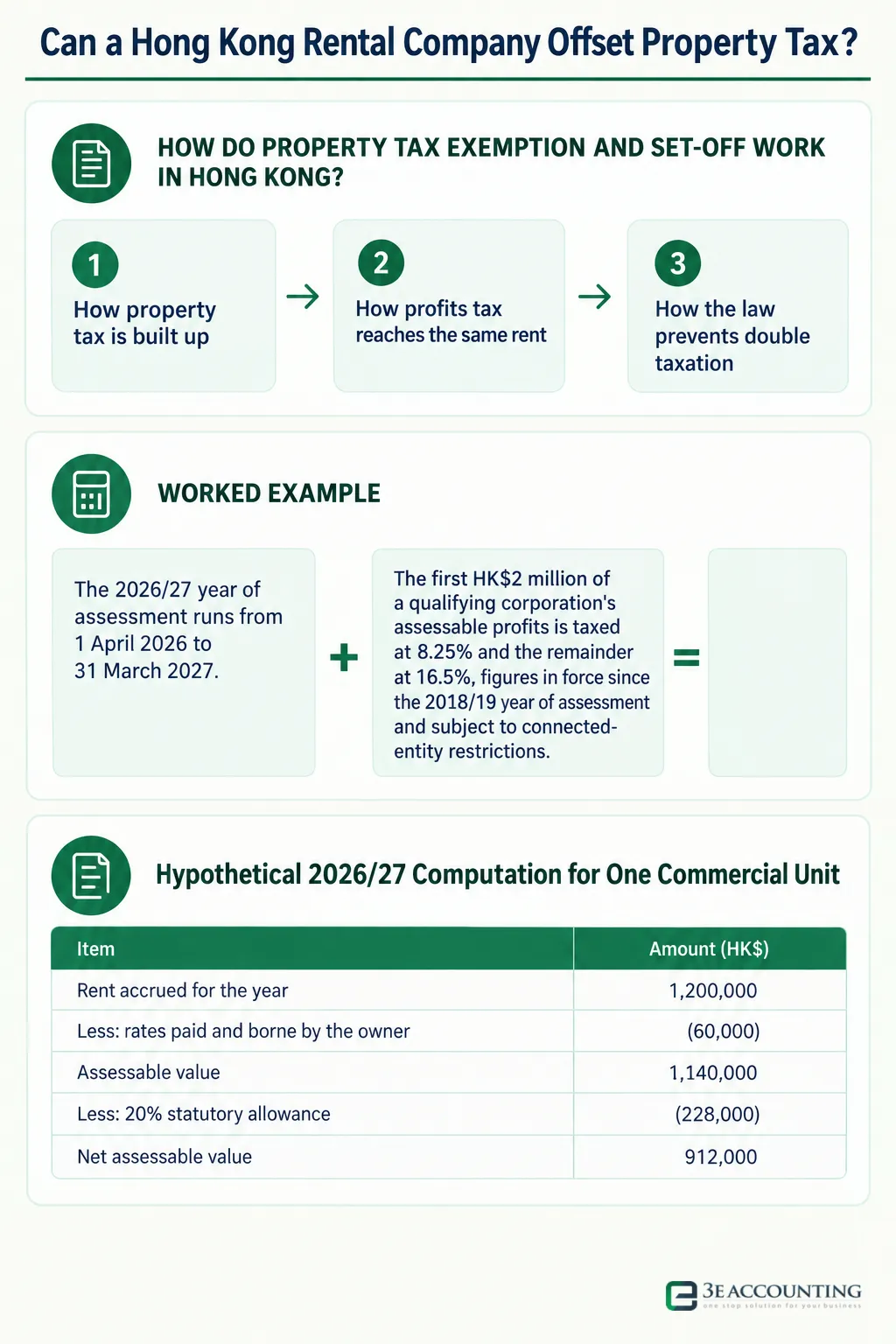
The 2026/27 year of assessment runs from 1 April 2026 to 31 March 2027. The property tax standard rate is 15%, unchanged since 2019/20. Corporate profits are taxed at the two-tiered rates that have applied since 2018/19. The first table below compares the two charges.
The interaction between the two taxes is summarised in the IRD's Brief Guide to Taxes for 2025-26, and it is where every planning decision starts.
1. How property tax is built up
Assessable value covers consideration for the right to use the property, including rent received or receivable and lump-sum premiums. It also includes service or management fees paid to the owner and the owner's expenses borne by the tenant. Amounts that become irrecoverable are deducted, but sums later recovered are taxed in the year of recovery.
From assessable value, deduct rates agreed to be paid and paid by the owner, not government rent or management fees. Then deduct the fixed 20% statutory allowance for repairs and outgoings. The result is the net assessable value, taxed at 15%. Actual repair costs, mortgage interest and management expenses do not supplement the 20% allowance for property tax purposes.
2. How profits tax reaches the same rent
The letting is reported in the company's BIR51 profits tax return. Check the applicable filing requirements for financial statements and a tax computation. Assessable profits start from accounting profits and are adjusted under the IRO.
Unlike the flat property tax base, the company's actual deductible expenses – rates, revenue repairs, rental-business interest and management costs – reduce assessable profits. The two charges therefore rarely produce matching numbers, which is why the relief mechanism matters.
3. How the law prevents double taxation
Property income may be chargeable to property tax and included in the company's profits for profits tax. In that case, property tax paid is set off against profits tax payable, and any excess is refunded.
As an alternative, a corporation may apply in writing to the Commissioner for exemption from paying the property tax that would otherwise be set off. Eligibility depends on ownership and the property's relationship to chargeable business profits. Exemption does not eliminate profits tax.
Property Tax vs Profits Tax for a Hong Kong Corporate Landlord
| Feature | Property tax | Profits tax |
|---|---|---|
| What it taxes | Ownership of Hong Kong land or buildings | Profits arising in or derived from a Hong Kong business |
| Rate (2026/27) | 15% standard rate on net assessable value | For eligible corporations, 8.25% on the first HK$2 million and 16.5% on the remainder; otherwise, generally 16.5% |
| Return | BIR58 property tax return | BIR51 profits tax return |
| Filing | Normally due within one month of issue | Normally due within one month of issue, subject to any applicable extension |
| Deduction base | Owner-paid rates plus the fixed 20% statutory allowance | Actual deductible business expenses and outgoings |
How Is Property Tax Credited Against Profits Tax Under Section 25?
Section 25 credits qualifying property tax the company has actually paid against its profits tax payable for the same year of assessment, and the IRD refunds any excess once the position is reconciled.
The set-off route assumes the property tax assessment is issued and paid. The company then reports the letting within its business and claims credit for the tax already handed over.
The credit depends on tax actually paid, so payment evidence anchors the whole claim. An assessment proves a charge; retain a receipt, bank statement or other payment confirmation to substantiate payment. Four steps are involved, and each carries its own deadline.
1. Return the rent and pay the assessment
The rent is returned in the BIR58 property tax return, normally due within one month of issue. The company pays the assessment by its stated instalment dates and keeps confirmation of every payment.
2. Report the letting in the profits tax return
The rental business goes into the BIR51. Check the notice and filing instructions for the required financial statements and tax computation. The BIR51 is generally due within one month of issue, although an applicable extension may depend on the accounting year end; check the deadline on each notice. We check each issued notice rather than assuming one date covers both.
3. Claim the credit and check the assessment
The claim identifies the property, the year of assessment, the property tax assessment reference and the payment. If the profits tax assessment leaves the credit out, we seek correction promptly.
A protective objection must normally reach the IRD within one month after the assessment notice date, stating the grounds. The tax generally remains payable while the objection is considered.
4. Reconcile provisional tax before counting cash
Provisional property tax and provisional profits tax usually sit alongside the final charges. The difference between two final figures is not automatically the refund received.
We reconcile provisional liabilities, credits and the actual assessment before treating any excess as cash. Neither a set-off request nor an exemption request, by itself, authorises non-payment.
What Does the Double Charge Look Like in Numbers?
In a hypothetical single-property example, property tax at 15% can exceed the qualifying two-tiered profits tax. The theoretical excess is not necessarily the cash refund.
Consider a hypothetical company owning one commercial unit for 2026/27, with accounts ending 31 March 2027. Assume HK$1,200,000 of rent accrues and the company pays and bears HK$60,000 of rates. Assume no vacancy, irrecoverable amounts, premiums, service-charge recoveries or other consideration.
Assume the letting is a Hong Kong business and these expenses are deductible for profits tax:
- Rates: HK$60,000
- Revenue repairs: HK$80,000
- Qualifying rental-business bank interest: HK$120,000
- Management fees: HK$24,000
- Insurance: HK$12,000
- Accounting and audit expenses: HK$24,000
The assumed HK$320,000 total leaves HK$880,000 in assessable profits. Assume no capital expenditure adjustments, capital allowances, brought-forward losses or other tax adjustments. The company also qualifies for the two-tiered rates, including the connected-entity restriction. The second table below works through both computations.
These figures are an unreviewed hypothetical illustration, not a client computation. A practitioner must confirm the figures, expense deductibility, rate eligibility, allowances and any applicable concession before publication. The example excludes provisional tax and concessions; the theoretical excess is not a cash-refund forecast. The rates applied are those the IRD's two-tiered profits tax rates regime FAQ sets out for qualifying corporations.
The cash-flow effect matters as much as the arithmetic. Suppose the final property tax assessment is issued in late 2027 and falls due in early 2028, with the profits tax assessment following months later. On those illustrative dates, the company funds HK$136,800 before the HK$72,600 profits tax liability is assessed. The HK$64,200 difference is theoretical; actual cash depends on reconciling provisional liabilities, credits and assessments.
Those dates are an illustration, not an IRD processing commitment. The IRD publishes service pledges for certain refunds, but targets are not guarantees and the applicable category must be confirmed for each case.
Hypothetical 2026/27 Computation for One Commercial Unit
| Item | Amount (HK$) |
|---|---|
| Rent accrued for the year | 1,200,000 |
| Less: rates paid and borne by the owner | (60,000) |
| Assessable value | 1,140,000 |
| Less: 20% statutory allowance | (228,000) |
| Net assessable value | 912,000 |
| Property tax at 15% | 136,800 |
| Assessable profits (rent less assumed deductible expenses of 320,000) | 880,000 |
| Profits tax at 8.25% (two-tiered rate) | 72,600 |
| Excess property tax refundable under the set-off | 64,200 |
How Does a Company Claim Property Tax Exemption on the BIR58?
A qualifying corporation claims exemption in Part 1 of its BIR58 return, completes Part 4 as well, or applies in writing to the Commissioner – and an application is not an approval.
The exemption power sits in section 5(2)(a) of the IRO, not section 16, which governs deductions for profits tax purposes. Two conditions drive eligibility: the company must own the property, and the property's income must be included in profits chargeable to profits tax. The same principle applies where the company occupies the property to produce its own chargeable profits.
Before claiming, we verify legal ownership against the title and the company's statutory records. A company that merely manages a property owned by its shareholder does not qualify on that fact alone. Registered particulars are checked through the Companies Registry in Hong Kong.
1. Complete the exemption claim in the BIR58
The corporate property tax return carries the exemption application in Part 1, and Part 4 must be completed as well. Returns are normally due within one month of issue, and the IRD issues property tax returns around the first working day of April.
Follow the issued return and its instructions. Filing the application is not the same as having it allowed.
2. Apply in writing where the return route does not fit
A corporation may instead apply in writing to the Commissioner for exemption. Confirm current application particulars and how to handle any existing assessment before proceeding. The letter should identify the company, property, assessment year and profits tax file.
We use the written route where return timing, or an assessment already issued, makes a letter more practical.
3. Deal with any assessment already issued
An exemption application does not withdraw an assessment or suspend collection. Where a bill is outstanding, respond expressly.
An objection must normally reach the IRD within one month after the assessment notice date, with the grounds stated. A qualifying provisional-tax holdover application is normally due by the later of two dates. These are 28 days before payment is due or 14 days after the notice is issued. Holdover is not automatic; check the tax, grounds, instalment and notice.
4. Notify changes within 30 days
Under section 5(2)(c), a company that has been exempted must notify the Commissioner in writing within 30 days of any change of ownership, change of use or other circumstance affecting the exemption.
Mixed occupation, part disposals and changes in letting arrangements are assessed on their own facts.
What Documents Does the IRD Need for Each Route?
Submit the required returns and supporting documents; retain underlying ownership, tenancy and payment records for substantiation. Check the notice, filing mode and applicable audit requirements and exceptions.
A working file and a submission bundle are not the same thing. We keep the underlying records to evidentiary standard, but only send what the specific return or enquiry requires.
For a set-off claim, payment evidence carries the claim: an assessment proves a charge, not a payment. The IRD requires businesses to keep sufficient records, and these annual filings sit within the wider corporate compliance requirements every Hong Kong company manages each year.
A corporate landlord's working file typically includes:
- company ownership evidence, business registration and tax file numbers
- signed tenancy agreements and any variations
- a rent ledger supported by bank receipts
- rates demands and proof the company bore the rates
- property tax assessments and payment confirmations
- financial statements, the auditor's report where required, and the tax computation
- loan documents and interest evidence for the rental business
Submit the returns and supporting documents required for the company, including accounts and a computation where applicable. Check the notice, filing mode and audit requirements and exceptions. Underlying records are produced when the IRD requests them, or when an ownership, income or payment point needs substantiating.
Which Route Should a Hong Kong Rental Company Choose: Exemption or Set-Off?
Our team generally favours exemption for an eligible ongoing rental company. Set-off can be a fallback when property tax is paid or exemption remains unresolved. This is professional judgement: ask a tax practitioner to confirm it for your circumstances. Neither request alone authorises withholding payment of a bill.
That preference is professional judgement rather than a statutory rule, and it must be tested against the company's own facts before either application is filed. The reasons are practical.
The Hong Kong company property tax exemption route avoids funding a 15% property tax bill while a refund is waited on. The set-off route locks that cash up in the meantime. Neither route produces an extra saving – the relief only stops the same rent being taxed twice.
The rate expectation also needs care. The first HK$2 million of a qualifying corporation's assessable profits is taxed at 8.25% and the remainder at 16.5%, figures in force since the 2018/19 year of assessment and subject to connected-entity restrictions. The third table sets the two routes side by side.
1. When exemption is usually the better route
An established rental business, with income clearly inside the profits tax computation, is the natural candidate. Exemption removes the pay-and-refund cycle altogether.
A loss or nil profits tax position needs a case-specific eligibility review. Ask a practitioner to confirm the section 5(2)(a) and section 25 analysis before choosing a route.
2. When set-off is the realistic option
Consider set-off where property tax has already been paid. If payment falls due before exemption is resolved, follow the notice and consider set-off after payment. The facts also matter where no exemption claim was made for the return year.
The claim work is then documentary: assessments, payment evidence and a reconciliation.
3. Facts that change the analysis
- Individual ownership follows a different analysis, including possible personal assessment, so the corporate choice does not apply to an individual owner
- Mixed use must be unpacked: third-party letting, company occupation, shareholder use and rent-free periods are not one rental stream
- A transfer of the property, the end of letting or a change of use can end the exemption and trigger the 30-day notification
- Holding property through a company is often chosen for continuity and liability reasons – the advantages of setting up a company in Hong Kong reach beyond tax
4. Where claims tend to go wrong
- Treating an exemption application as suspending an issued bill. It does not, and overdue-tax consequences can accrue while the substantive point is argued
- Deducting property tax in the profits tax computation. Check the adjustment required for tax charged under the IRO and any separate credit claim
- Assuming the HK$2 million band makes profits tax-free
- Expecting a fixed refund timetable, or reading the gap between two final assessments as cash without reconciling provisional tax
- Forgetting the 30-day notification duty when ownership or use changes.
Exemption vs Set-Off at a Glance
| Feature | Exemption route | Set-off route |
|---|---|---|
| Legal basis | Section 5(2)(a) application | Section 25 credit |
| When it starts | On approval for an eligible year of assessment | After qualifying property tax is paid |
| How to claim | Part 1 of the BIR58 (with Part 4) or a written application to the Commissioner | Credit claimed through the BIR51 with payment evidence |
| Cash-flow effect | No property tax bill to fund | Company funds the bill, then waits for any excess to be refunded |
| Main risk | Assuming the application suspends an issued assessment | Reconciling provisional tax and refund timing |
Conclusion
An eligible company can obtain relief when the same rent is subject to both property tax and profits tax. Our team generally favours exemption for an eligible ongoing rental company, using the BIR58 or a written application. That is professional judgement, not a statutory rule; ask a tax practitioner to confirm it for your circumstances. Section 25 set-off can help where property tax has already been paid. Reconcile provisional liabilities, credits and assessments before treating any excess as cash.
The choice turns on ownership, the property's use and timing – not on the size of either bill. No application, objection or holdover authorises ignoring an issued assessment on its own, so both routes reward early, well-documented filing.
As a Corporate Services Provider, 3E Accounting Hong Kong helps corporate landlords prepare BIR58 and BIR51 filings. Our team also helps assess exemption eligibility, document set-off claims and reconcile provisional tax. Speak to our tax team before the next property tax assessment lands.
Review your rental company's property tax route
Share your latest BIR58 or assessment notice and we will map the exemption or set-off route for your company.
Frequently Asked Questions
Yes. A corporation whose property income is included in profits chargeable to profits tax may apply for exemption under section 5(2)(a) of the IRO, through the BIR58 return or a written application to the Commissioner.
Exemption stops the property tax charge before payment. Set-off, under section 25, credits property tax already paid against profits tax on the same income, and the IRD refunds any excess.
Yes, where the property income is included in the profits chargeable to profits tax, the excess is refunded. Provisional property tax and provisional profits tax must be reconciled first, because the gap between two final figures is not automatically cash received.
No. Since the 2018/19 year of assessment, the first HK$2 million of a qualifying corporation's assessable profits is taxed at 8.25% and the remainder at 16.5%, subject to connected-entity restrictions. The figure is a rate band, not an allowance.
No. An application is not an approval and does not suspend collection. An objection must normally reach the IRD within one month after the assessment notice date, and the tax generally remains payable unless a qualifying holdover is granted.

Abigail Yu
Director
Abigail Yu oversees executive leadership at 3E Accounting Group, leading operations, IT solutions, public relations, and digital marketing to drive business success. She holds an honors degree in Communication and New Media from the National University of Singapore and is highly skilled in crisis management, financial communication, and corporate communications.