

What Are the Key Hong Kong Tax and Compliance Changes for 2026-27?
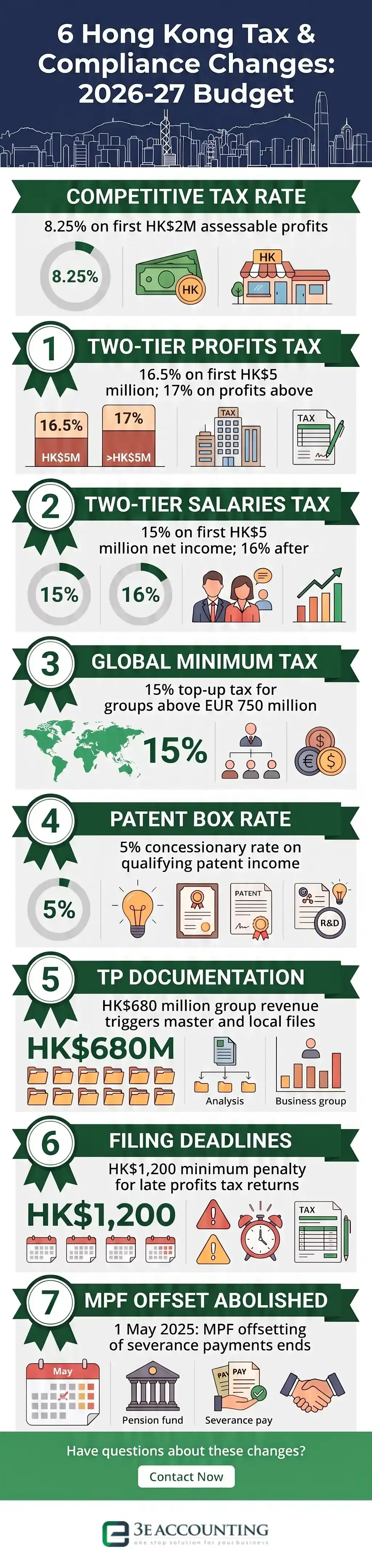
At 8.25% on the first HK$2 million of assessable profits, Hong Kong remains one of the world's most tax-competitive places to do business. But the rules around that headline rate are changing fast. The Hong Kong 2026-27 budget tax framework carries legislated measures from recent Budgets into force:
- Two-tiered standard tax rates
- The global minimum tax
- A 5% patent box
- Revised employment obligations
Each of these now shapes every filing calendar. For startups and multinational groups alike, HK compliance updates 2026 determine deadlines, penalties and available concessions. In this infographic, we set out the key tax changes for 2026 and 2027. These are the numbers that matter for your next return.
What Are the Two-Tiered Profits Tax Rates?
Hong Kong's two-tiered profits tax rates are 8.25% on the first HK$2 million of assessable profits and 16.5% on the remainder. The structure took effect from the year of assessment 2018/19, so it now flows through 2026 filings and tax provisioning. Unincorporated businesses follow the same split at 7.5% and 15%. Separate rate rules introduced under the 2025-26 Budget apply to multinational enterprise groups within the global minimum tax framework from the year of assessment 2025/26, so affected groups should confirm the rates that apply to them rather than assume the headline figures. Companies above the HK$2 million threshold should model the impact before year-end.
What Are the Two-Tiered Salaries Tax Rates?
Standard-rate salaries tax is 15% on the first HK$5 million of net income and 16% on the remainder. Introduced from the year of assessment 2024/25, the same two-tiered structure applies to tax under personal assessment at 16% and 17%. Only the highest earners are affected. Yet boards should review remuneration packaging for directors and senior staff. Personal assessment elections now carry measurable value at these income levels.
How Does the Global Minimum Tax Apply in Hong Kong?
A 15% domestic minimum top-up tax now applies in Hong Kong. It targets multinational enterprise groups with consolidated revenue of EUR 750 million or more. The Inland Revenue Department (IRD) administers the charge for fiscal years beginning on or after 1 January 2025, so first top-up amounts fall within 2026. Affected groups need GloBE-level data on every Hong Kong entity, reconciled with existing profits tax filings to avoid double counting.
How Does the 5% Patent Box Rate Work?
Qualifying patent-derived income is taxed at a concessionary 5% under Hong Kong's patent box regime. Effective from the year of assessment 2025/26, the regime covers qualifying patents and plant variety rights. The election is lodged through the profits tax return. Businesses already claiming research and development deductions should test whether registered intellectual property unlocks the lower rate. Qualifying and non-qualifying income must be segregated in the computation.
Hong Kong Tax and Compliance Changes at a Glance: 2026-27
| Measure | Key Figure | Effective Date |
|---|---|---|
| Two-tiered profits tax | 8.25% on first HK$2 million of assessable profits; 16.5% above | Year of assessment 2018/19 |
| Two-tiered salaries tax (standard rate) | 15% on first HK$5 million of net income; 16% above | Year of assessment 2024/25 |
| Global minimum top-up tax | 15% top-up for groups with consolidated revenue of EUR 750 million or more | Fiscal years beginning on or after 1 January 2025 |
| Patent box | 5% concessionary rate on qualifying patent income | Year of assessment 2025/26 |
| Transfer pricing documentation | Master and local files required above HK$680 million group revenue | On notice from the Inland Revenue Department |
| Late profits tax return penalty | HK$1,200 minimum penalty | 1 May deadline for 31 December year-ends |
| MPF offsetting | Offsetting of severance and long-service payments abolished | 1 May 2025 |
When Is Transfer Pricing Documentation Required?
Master files are required once an MNE group's total revenue exceeds HK$6.8 billion. Local files are required for each Hong Kong entity unless it satisfies the applicable business-size test together with the related-party-transaction thresholds set out in the Inland Revenue Department's guidance. Cross-border pricing arrangements should be documented as they arise, because the Inland Revenue Department can request the files on notice and surcharges follow non-compliance.
What Are the Filing Deadlines and Penalties?
Late filing of a profits tax return attracts a minimum penalty of HK$1,200, and additional assessments can follow. Most profits tax returns are issued on the first working day of April, with a 1 May deadline where the accounting period ends on 31 December, unless the return is covered by a block extension arranged through a tax representative. The same calendar intersects the 7 post-incorporation compliance steps in Hong Kong, so a single consolidated compliance diary protects every deadline.
What Changed When MPF Offsetting Was Abolished?
MPF offsetting of severance and long-service payments ended on 1 May 2025. Employers must now fund these payments without drawing on accrued Mandatory Provident Fund benefits. A government subsidy programme phases in the extra employer cost. Payroll systems, contracts and reserves all need updating, and businesses that streamline these obligations also cut HK company secretarial compliance costs.
Ready to Align With Hong Kong's 2026-27 Tax Changes?
Our Corporate Professional Advisors map every rate, deadline and filing duty to your structure — reach out today.
Frequently Asked Questions
The headline two-tiered rates are unchanged: 8.25% on the first HK$2 million of assessable profits and 16.5% on the remainder, in force since the year of assessment 2018/19. Groups within the global minimum tax framework should confirm the rates that apply to them, as separate rules introduced under the 2025-26 Budget apply to them from the year of assessment 2025/26.
It applies to multinational enterprise groups with consolidated revenue of EUR 750 million or more, for fiscal years beginning on or after 1 January 2025, with Hong Kong administering a domestic minimum top-up tax.
Qualifying patent-derived income is taxed at a concessionary 5%, effective from the year of assessment 2025/26, with the election lodged through the profits tax return.
Master files are required once an MNE group's total revenue exceeds HK$6.8 billion. Local files are required for each Hong Kong entity unless the applicable business-size and related-party-transaction exemption tests are met, and must be produced when the Inland Revenue Department requests them on notice.
Late filing attracts a minimum penalty of HK$1,200, with the Inland Revenue Department entitled to assess additional amounts depending on the circumstances.

Abigail Yu
Author
Abigail Yu oversees executive leadership at 3E Accounting Group, leading operations, IT solutions, public relations, and digital marketing to drive business success. She holds an honors degree in Communication and New Media from the National University of Singapore and is highly skilled in crisis management, financial communication, and corporate communications.